Table of contents7 sections
- Why Apprenticeships Were Mistaken for an Entry-Level Hiring Tool
- What the Apprenticeship (Amendment) Rules, 2025 Changed for Employers
- Three Ways Leading Employers Use Apprenticeships as Talent Pipeline Solutions
- A Maturity Ladder for Corporate Apprenticeship Programmes
- The Apprenticeship's Next Chapter
- References
- Frequently asked questions
For most of its history in India, the apprenticeship sat in the compliance file. A company with thirty or more workers engaged a prescribed number of apprentices because the Apprentices Act required it, placed them in junior roles and moved on. Headcount was the metric. Capability was rarely discussed.
That framing is out of date. The India Skills Report 2026 puts overall employability at 56.35 per cent, up from 54.81 per cent a year earlier (Careers360, 2025). Yet a test score measures readiness in the abstract, while an apprenticeship measures it inside a live job. Employers who grasp that difference are quietly turning a statutory obligation into their most dependable talent pipeline.
Why Apprenticeships Were Mistaken for an Entry-Level Hiring Tool
Three habits explain the misreading. Apprenticeships were built around trades and technicians, so many leaders still associate them with the shop floor rather than the whole enterprise. They were budgeted as a cost of compliance, which made the cheapest placement the best one. And they were measured at the point of entry, by how many were engaged, rather than at the point of exit, by what they became.
Employers' own signals show how far perception lags practice. In NIIT's India Skills Gap Report 2026, 24 per cent of employers said they value apprenticeship experience as an alternative credential, behind micro-credentials at 38 per cent and industry certifications at 28 per cent (NIIT, 2026). Apprenticeship experience is respected, but not yet treated as proof of capability. That gap is the opportunity.
What the Apprenticeship (Amendment) Rules, 2025 Changed for Employers
The amended rules came into force on 11 September 2025 and altered both the economics and the scope of the programme (SGCMS, 2025). The changes that matter most to a talent leader are summarised below.
Public support sits alongside these rules. Under the National Apprenticeship Promotion Scheme (NAPS), the government shares 25 per cent of the stipend, up to ₹1,500 a month, and more than 47.5 lakh apprentices have been engaged across over 45 sectors since 2022–23 (Superkalam, 2026a). I would treat that reimbursement as a welcome offset, never as the business case. A programme that only works with a subsidy is a subsidy, not a strategy.
Three Ways Leading Employers Use Apprenticeships as Talent Pipeline Solutions
Employer appetite has moved well beyond compliance. TeamLease Degree Apprenticeship's industry outlook found that eight in ten employers intended to raise apprentice intake, with its Net Apprenticeship Outlook at a record 76 per cent. Healthcare, electronic systems, telecommunications and BFSI led, each with over 85 per cent of employers increasing intake (TeamLease Degree Apprenticeship, 2025). Participation is also broad: 57,945 establishments, 38,936 of them MSMEs, have registered under NAPS since 2018–19 (Superkalam, 2026b).
A trial before the hire. The apprenticeship period works as an extended, paid assessment. Employer and apprentice both see performance in context before a permanent offer is made, which is a far better predictor than an interview.
A pipeline into scarce roles. Where a role is hard to fill externally, such as a technician for automated lines or a cloud operations associate, the employer can design the apprenticeship backwards from the role. The task list, not the job title, sets the curriculum.
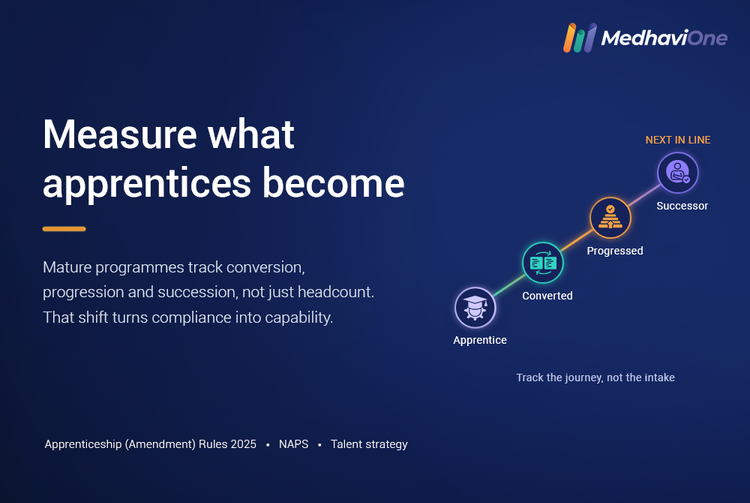
A progression engine. The most mature programmes treat the apprenticeship as the first rung of a ladder. Apprentices move into supervisory and specialist tracks, and the company builds its own succession bench.
A Maturity Ladder for Corporate Apprenticeship Programmes
Most organisations sit on the lower rungs without realising it. The ladder below describes four stages and, more usefully, the measure that signals each one. Moving up is less about enrolling more apprentices than about changing what leadership asks of the programme.
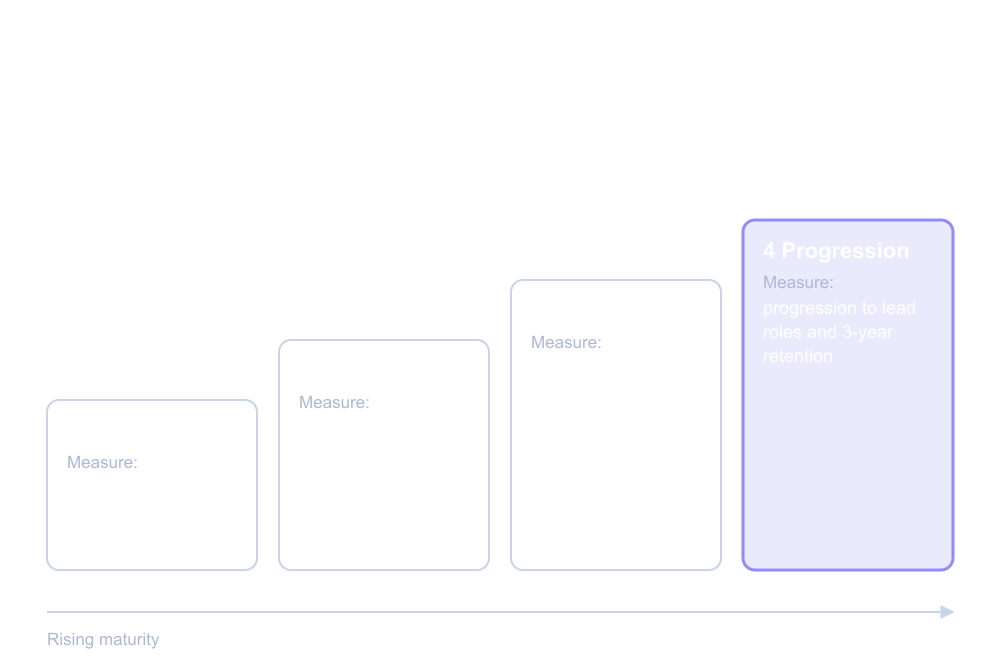
If your dashboard stops at the first rung, the programme will behave like a compliance exercise, because that is all it is being asked to do.
The Apprenticeship's Next Chapter
The apprenticeship is shifting from a way of filling junior vacancies to a way of growing the people a business will need in three years. MedhaviOne's Enterprise Solutions works at this intersection, helping employers map roles and capabilities and build work-integrated pathways supported by Recognition of Prior Learning.
The question for the next planning cycle is simple: is your apprenticeship programme filling seats, or building talent?
References
AMLegals (2025) The Apprenticeship Amendment Rules 2025: strengthening compliance, equity and employability. AMLegals.
AscentHR (2025) Apprenticeship (Amendment) Rules, 2025. AscentHR, 11 September.
Careers360 (2025) India Skills Report 2026: employability reaches 56.35% as nation emerges as global talent hub. Careers360.
Lexplosion (2025) Ministry of Skill Development and Entrepreneurship notifies Apprenticeship (Amendment) Rules, 2025. Lexplosion.
NIIT (2026) India Skills Gap Report 2026. NIIT.
SGCMS (2025) Apprenticeship (Amendment) Rules, 2025. SGCMS Regulatory Updates, 16 September.
Superkalam (2026a) Apprenticeship training under NAPS. Superkalam Current Affairs, 21 July.
Superkalam (2026b) Salient features of NAPS-2. Superkalam Current Affairs, 28 July.
TeamLease Degree Apprenticeship (2025) Apprentice hiring in India: industry trends and forecast. TeamLease Degree Apprenticeship, 21 February.
Frequently asked questions
It is a structured, work-based programme in which an employer engages apprentices under the Apprentices Act, 1961, pays a stipend and trains them on the job against defined roles. Done well, it feeds a pipeline into permanent positions.
Under the Apprenticeship (Amendment) Rules, 2025, establishments engage apprentices amounting to 2.5 to 15 per cent of total strength, including contract staff, with at least 5 per cent reserved for freshers and skill certificate holders (SGCMS, 2025).
Under NAPS, the government shares 25 per cent of the stipend, up to ₹1,500 per month, through direct benefit transfer (Superkalam, 2026a).
An apprenticeship runs under a statutory framework with a minimum stipend and structured on-the-job training. Internships generally lack that framework and are shorter.