Table of contents9 sections
- Why RPL Assessment is a Quality Question
- How Certificate Inflation Devalues Every RPL Certificate
- How Is RPL Assessed? The Standards Behind a Credible Judgement
- Five RPL Evidence Methods and What Each Can Prove
- NSQF Alignment: Mapping Every Piece of Evidence to a Standard
- Seven Warning Signs of Certificate Inflation
- What Enterprises Should Ask Before Commissioning RPL
- References
- Frequently asked questions
Why RPL Assessment is a Quality Question
Recognition of Prior Learning (RPL) has moved from the margins of India's skilling system to its centre. It has been a core component of the Pradhan Mantri Kaushal Vikas Yojana since 2016 (MSDE). The National Credit Framework, introduced in 2023, now lets validated learning count towards credits rather than ending at a certificate (Ministry of Education, 2023).
That shift raises the stakes. When a certificate could only open a door to a job, a weak assessment was a local problem. When it can carry academic credit, justify a promotion or satisfy a client audit, every weak assessment becomes a system problem.
For enterprises, the useful question is no longer "How many of our people can we certify?" It is "Would this certificate hold up if a regulator, a client or a new manager tested it?" The answer depends almost entirely on how the assessment was designed.
How Certificate Inflation Devalues Every RPL Certificate
A certificate is a signal. It tells someone who has never watched the holder work that the holder can do the job to a stated standard. Signals only work while the people reading them trust the process behind them.
Economists have described this pattern since George Akerlof's work on the "market for lemons" (Akerlof, 1970). When buyers cannot tell good products from poor ones, they discount all of them. Skill certificates behave the same way. If some assessments are rushed or lenient, employers begin to discount every certificate, including those earned through rigorous evaluation.
The costs land inside the enterprise:
- Misdeployment: staff certified as ready are placed in roles they cannot yet perform.
- Safety and quality risk: in logistics, manufacturing and healthcare, an unverified skill can become an incident.
- Compliance exposure: a certificate that cannot be traced to evidence offers little protection in an audit.
- Wasted training spend: the gap the certificate concealed must later be closed anyway, usually under more pressure.
The practical lesson is simple. An RPL programme should be judged by the quality of its evidence, not by its pass rate.
How Is RPL Assessed? The Standards Behind a Credible Judgement
Credible RPL rests on two sets of tests: four principles that govern the assessment itself, and four rules that govern the evidence. Mature systems such as Australia's vocational framework, overseen by the Australian Skills Quality Authority (n.d.), make these explicit. The UNESCO Institute for Lifelong Learning (2012) guidelines on validating non-formal and informal learning follow similar logic.
| Test | Type | The question an assessor must answer |
|---|---|---|
Fairness deserves particular attention in India. A machine operator with twenty years of experience may struggle with a written English test. That reveals a literacy barrier, not a skill gap. Assessment in the candidate's working language, or through demonstration, keeps the judgement on the skill itself.
Five RPL Evidence Methods and What Each Can Prove
No single method satisfies all eight tests. Credible RPL combines methods so that each covers the others' blind spots.
The professional conversation is often underused. Asking a warehouse lead "What do you do when the system shows stock that isn't on the shelf?" reveals more about competence than a multiple-choice paper. It also suits candidates whose knowledge is spoken rather than written, which describes a large share of India's experienced workforce.
NSQF Alignment: Mapping Every Piece of Evidence to a Standard
In India, credible RPL is anchored in the National Skills Qualifications Framework (NSQF). Qualifications developed by Sector Skill Councils and approved by the National Council for Vocational Education and Training (n.d.) are built from National Occupational Standards. Each standard is broken into specific performance criteria.
NSQF alignment means every assessment decision can be traced to a criterion and to the evidence that satisfied it. The tool that makes this possible is an assessment blueprint: a plan, written before any candidate is assessed, that sets which methods cover which criteria and how much weight each carries.
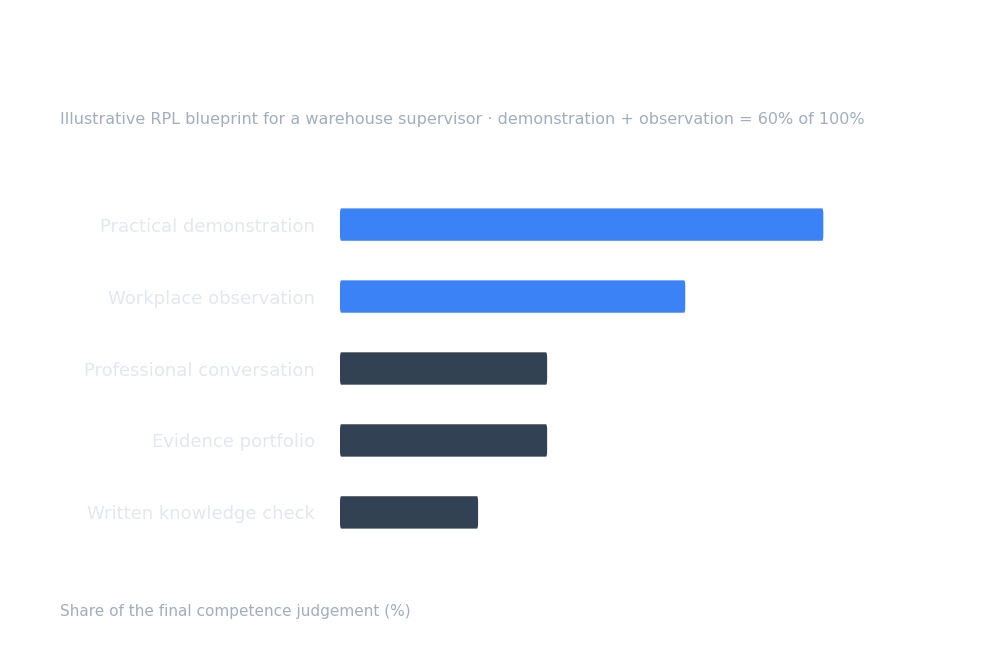
Weightings should follow the role. A records-heavy role may lean on portfolios; a ward assistant's assessment should lean on observation. What matters is that the blueprint is fixed in advance and applied the same way to every candidate. A second assessor should then re-check a sample of decisions, a step known as moderation, to confirm reliability.
Seven Warning Signs of Certificate Inflation
Quality and compliance teams can audit an RPL programme, internal or outsourced, against these signals. Any one of them warrants a closer look; several together suggest the certificates may not withstand scrutiny.
- Large cohorts assessed in a single day, with minutes per candidate.
- Pass rates at or near 100% across batches, sites and assessors.
- Assessment by written test alone for practical, hands-on roles.
- The same organisation trains, assesses and certifies, with fees tied to pass volumes.
- No retained evidence, so no decision can be traced back to what the candidate showed.
- Identical portfolio documents or answers across candidates.
- No route for candidates who fall short, such as a gap-training bridge or reassessment.
The last sign is often missed. A system in which nobody can "not yet" pass is not assessing; it is issuing paperwork.
What Enterprises Should Ask Before Commissioning RPL
A credible RPL pathway treats "not yet competent" as a result to act on, not a failure to hide.
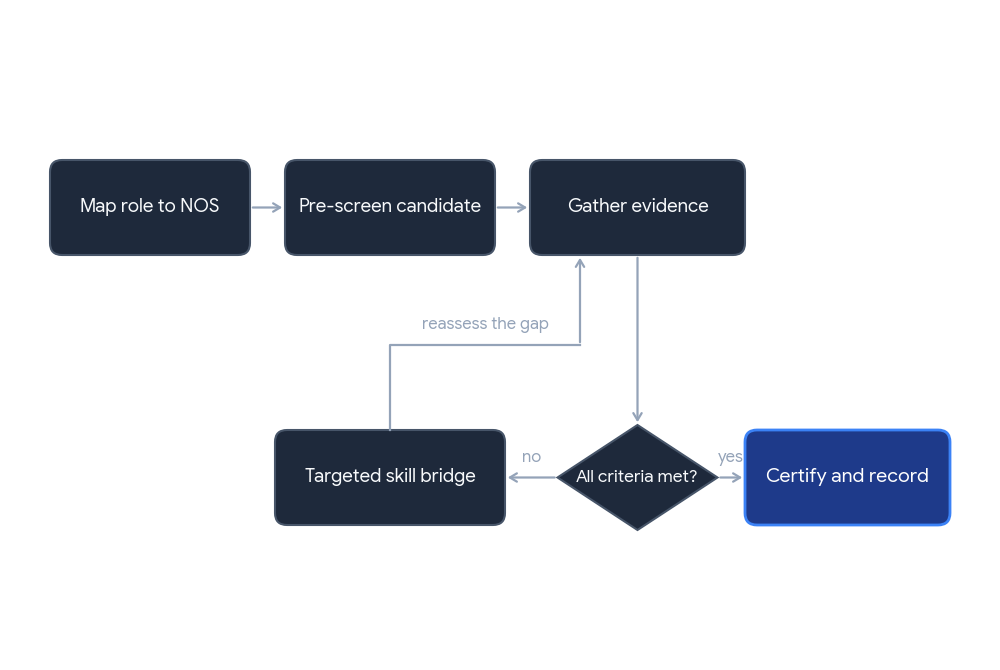
Candidates who fall short on specific criteria move into a short, targeted bridge and are reassessed only on that gap. No one repeats what they have already proved.
Before engaging an RPL partner, L&D and compliance teams should be able to get clear answers to six questions:
- Can we see the assessment blueprint for each role before assessment begins?
- How are assessors qualified, and are they independent of the trainers?
- What evidence is retained, in what form and for how long?
- How is moderation carried out, and what share of decisions is re-checked?
- What happens to candidates who are not yet competent on some criteria?
- Can candidates be assessed in their working language?
MedhaviOne Enterprise Solutions builds RPL on this logic: role and capability mapping first, NSQF-aligned assessment next, and targeted upskilling where gaps appear, with routes into work-integrated and credit-bearing education where relevant.
Recognition is valuable only when it can be trusted. For enterprises, that trust is built one well-evidenced decision at a time.
References
Akerlof, G.A. (1970) 'The market for "lemons": quality uncertainty and the market mechanism', The Quarterly Journal of Economics, 84(3), pp. 488–500.
Australian Skills Quality Authority (n.d.) Australian Skills Quality Authority. Available at: asqa.gov.au
Ministry of Education (2023) National Credit Framework (NCrF). New Delhi: Government of India.
Ministry of Skill Development and Entrepreneurship (n.d.) Pradhan Mantri Kaushal Vikas Yojana. Available at: pmkvyofficial.org
National Council for Vocational Education and Training (n.d.) National Council for Vocational Education and Training. Available at: ncvet.gov.in
UNESCO Institute for Lifelong Learning (2012) UNESCO guidelines for the recognition, validation and accreditation of the outcomes of non-formal and informal learning. Hamburg: UNESCO Institute for Lifelong Learning.
Frequently asked questions
RPL is assessed against the National Occupational Standards in an NSQF-aligned qualification. Assessors combine methods such as practical demonstration, workplace observation, professional conversation and evidence portfolios, then judge each performance criterion.
Acceptable evidence includes work samples, logs and records, supervisor reports, observed performance and answers in structured interviews. It must be valid, sufficient, authentic and current.
Certificate inflation occurs when certificates are issued without enough evidence of competence. It lowers the value of all certificates, because employers can no longer trust what any one of them signals.
Yes, and a credible system expects some candidates to be "not yet competent" on certain criteria. Good programmes then offer targeted gap training and reassessment rather than a full course.
Ask for its assessment blueprint, evidence retention policy, assessor qualifications, moderation process and pass-rate data by batch. A partner that cannot share these is unlikely to withstand an audit.