Table of contents8 sections
- What Is an ABC ID, and Where Does DigiLocker Fit?
- How a Credit Travels, and Where the Institution Sits
- Four Things Institutional Systems Must Be Able to Do
- Identity Is Racing Ahead of Credit Records
- A Practical Test: Follow One Credit From Result to Recipient
- What Institutional Leaders Should Take From This
- References
- Frequently asked questions
Ask a registrar what the Academic Bank of Credits (ABC) does and the answer is usually policy language: flexibility, mobility, multiple entry and exit. Ask how a credit actually leaves the institution and the answer is usually a pause. Across education and corporate settings, I have seen the gap between a sound policy and a working system open up in the same place every time. It is rarely about intent. It is about plumbing. NEP 2020 set the goal, the UGC wrote the rules, and the national infrastructure now exists. The first mandatory upload deadline has already passed. What remains is whether each institution's own systems can issue, receive and verify a credit record on demand.
What Is an ABC ID, and Where Does DigiLocker Fit?
The Academic Bank of Credits is a digital store for academic credits, run under the Ministry of Education and regulated by the UGC. Its roots lie in section 11.9 of NEP 2020, which proposed a bank that digitally stores credits earned at recognised institutions so that degrees can account for them (MoE, 2020; UGC, 2021a).
People often say "ABC ID", but the identifier now doing the work is the APAAR ID, a unique 12-digit student number under the "One Nation, One Student ID" initiative. It is linked to Aadhaar and DigiLocker, and it ties a learner's records to one identity (PIB, 2026). The National Academic Depository (NAD) is the backbone that stores awards and records. Students then see verified records in DigiLocker.
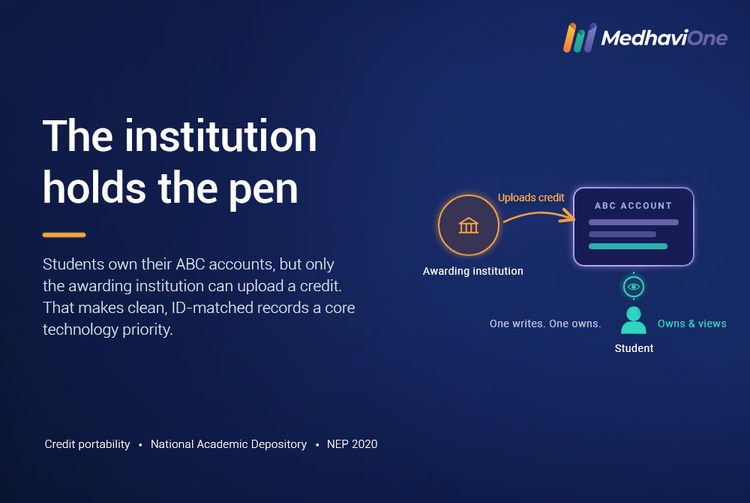
One rule in the regulations changes how institutions should think about all of this. The ABC accepts course-credit documents only from the awarding institution, never directly from the student (UGC, 2021a). The student owns the account. The institution holds the pen.
How a Credit Travels, and Where the Institution Sits
The journey below follows the flow in the Press Information Bureau's 2026 factsheet and the 2021 regulations (PIB, 2026; UGC, 2021a).
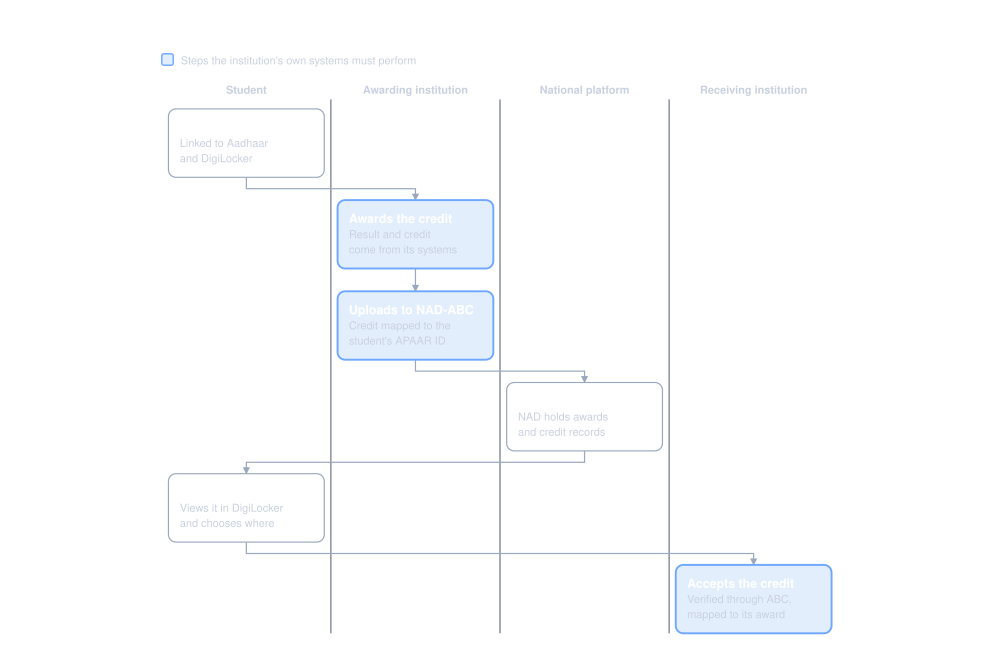
Three of the six steps sit inside an institution's own systems. The national platform stores and displays a record, but it cannot create one.
Four Things Institutional Systems Must Be Able to Do
Policy documents describe outcomes. Systems have to perform tasks. Translated from the framework, four tasks fall squarely on the institution.
Identity Is Racing Ahead of Credit Records
As on 2 July 2026, 2,899 higher education institutions were registered, with 4.79 crore APAAR IDs created and mapped and 9.78 crore credit records mapped (PIB, 2026). Dividing records by IDs shows where identity has moved faster than results.
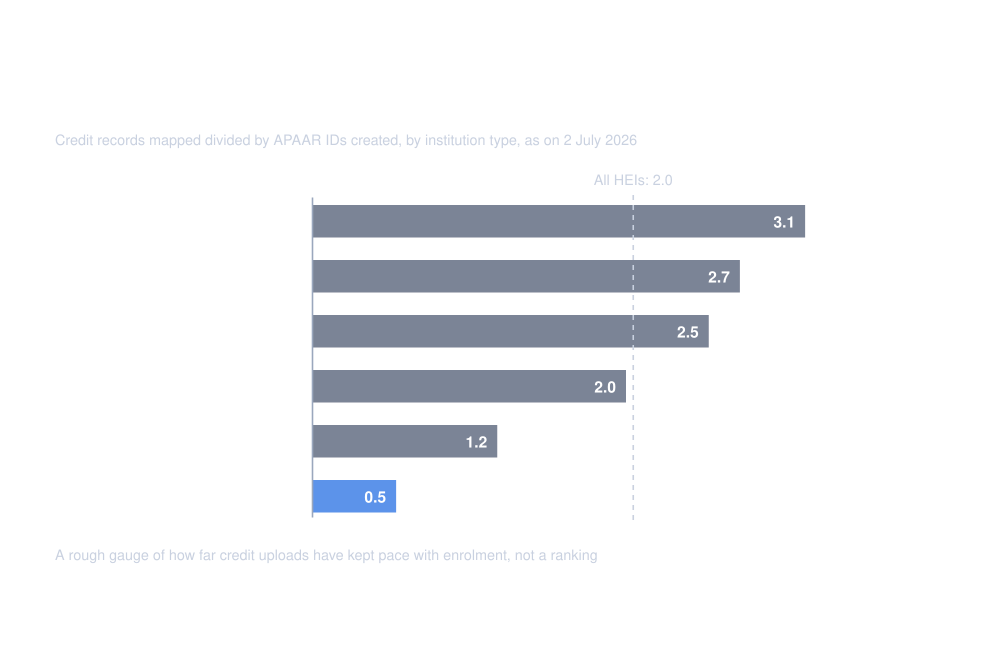
Where the ratio is low, students have been given an identity but their credits have not yet followed. The pattern points to the same bottleneck the diagram shows: the upload step, which only the institution can perform.
A Practical Test: Follow One Credit From Result to Recipient
Readiness is easier to judge by tracing than by auditing. Pick one student who completed a semester in 2025 and follow a single credit.
Start where the result is born. Find the system that holds the final grade and credit value. If it is an exam register or a spreadsheet, that is the first gap, because every later step depends on this record being clean.
Check the identity match. Confirm that the student's APAAR ID sits against the same record the credit lives in. Where identity and results are held in different places, matching them by hand is where uploads stall.
Then reverse the direction. Take a credit arriving from elsewhere, such as a SWAYAM or NPTEL course, and ask where it would be recorded, who would approve it and how it would map to your programme structure (UGC, 2021a). Institutions often rehearse the outbound path first. The inbound one deserves equal attention.
What Institutional Leaders Should Take From This
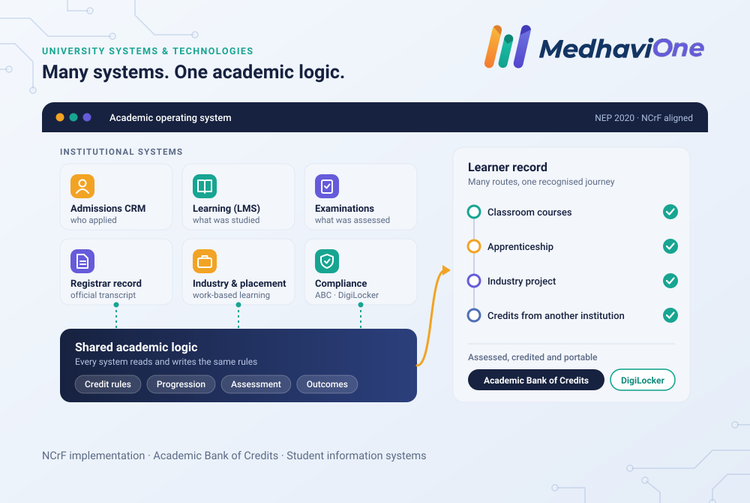
Credit portability changes what a student record is. It used to be an internal archive, consulted at graduation. It is becoming a shared, verifiable asset that other institutions, employers and the learner will read (PIB, 2026). That raises the bar for the technology behind it: the student information system, examination and fee records and credential issuance must behave as one record, not four.
This is why unified platforms, such as MedhaviOne's University Systems & Technologies (MUST), treat DigiLocker and ABC credit integration as part of the core learner lifecycle rather than a late addition. The test for any institution is simpler: can one credit, for one student, travel from your system to someone else's without a person retyping it?
A credit that cannot travel is only a number in a register.
References
Ministry of Education (2020) National Education Policy 2020. New Delhi: Government of India.
Press Information Bureau (2026) Academic Bank of Credits and APAAR: Building India's lifelong learning ecosystem. Factsheet, 4 July 2026. New Delhi: Government of India.
University Grants Commission (2021a) UGC (Establishment and Operation of Academic Bank of Credits in Higher Education) Regulations, 2021. New Delhi: University Grants Commission.
University Grants Commission (2021b) UGC (Establishment and Operation of Academic Bank of Credits in Higher Education) (First Amendment) Regulations, 2021. New Delhi: University Grants Commission.
Frequently asked questions
The Academic Bank of Credits gives each student an individual account with a unique ID (UGC, 2021a). In current practice the 12-digit APAAR ID is the identifier that links a learner's records to that account, to Aadhaar and to DigiLocker (PIB, 2026).
ABC is the digital store for academic credits. APAAR is the unique student identifier. The National Academic Depository (NAD) is the backbone that securely stores academic awards and records (PIB, 2026).
In the flow described by the Press Information Bureau, an institution uploads credit data against each student's APAAR ID to the NAD-ABC portal, and students then view verified records in DigiLocker (PIB, 2026). The institution's task is to produce clean, ID-matched credit data. Technical specifications should be confirmed with the NAD-ABC portal directly.
No. The regulations provide that the ABC accepts course-credit documents only when the awarding institution transmits them (UGC, 2021a).
The 2021 first amendment names universities and autonomous colleges that meet the stated criteria, along with Institutions of National Importance (UGC, 2021b). The 2026 progress report also lists standalone institutions and skill awarding bodies, so institutions should check current eligibility on the ABC portal (PIB, 2026).