Table of contents8 sections
India's Hotel Expansion Has a Leadership Problem
India's hotel growth is usually described in keys, signings and occupancy. The EHL Hospitality Outlook 2026 for India, published in June, describes it through people. Its conclusion is direct: talent is the sector's most pressing challenge, and the constraint is not only frontline headcount. In EHL's assessment, high attrition, uneven middle-management skills and leadership shortages are holding back the industry's ability to scale sustainably (EHL, 2026).
One observation in the report deserves more attention than it has received. As brands move experienced managers to staff new properties, professionals may step into leadership roles before they are fully prepared (Behane, 2026). India's expansion is quietly producing a generation of accidental managers: capable people promoted by circumstance rather than readiness. This is not a failing of individuals. It is a design flaw in how the industry builds its leadership pipeline.
Where India's Hotel Growth Is Heading
The geography of growth explains the pressure. India recorded over 2.9 billion domestic tourist visits in 2024, a rise of 17.51% on the previous year, and tier 2 and tier 3 markets accounted for nearly half of all hotel property transactions that year (EHL, 2026).
EHL does not treat these markets as a single category. It identifies four city archetypes, each with its own leadership demands. In pilgrimage hubs such as Varanasi and Tirupati, extreme peaks make workforce planning critical. In leisure and wedding destinations such as Udaipur and Kochi, coordination across departments protects yield. In infrastructure-led cities such as Navi Mumbai, limited local talent means training systems must be built early. In regional business centres such as Lucknow and Coimbatore, middle-management capability is the primary driver of performance (EHL, 2026).
Across these archetypes, the recurring constraint sits below the general manager: the shift lead, the supervisor and the department head.
How the Middle-Management Gap Forms
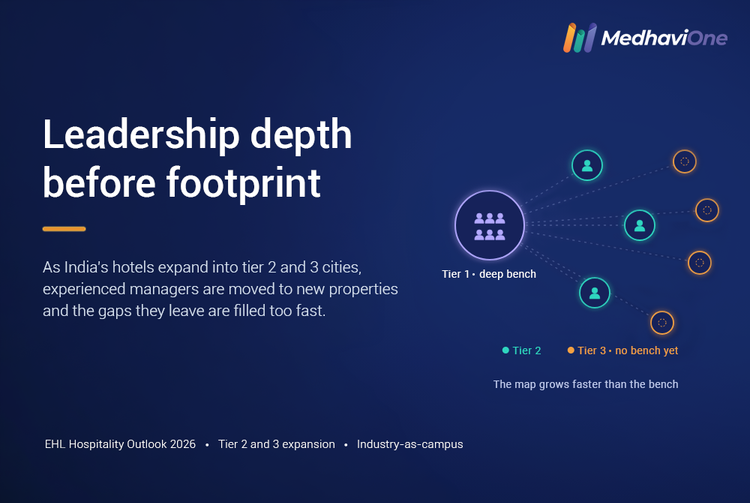
The report describes a mechanism familiar to anyone who has watched a hotel group expand. Frontline teams in emerging cities are usually recruited locally, because local staff carry cultural knowledge that guests now expect and that is difficult to transfer. Managers, by contrast, are often reassigned from established cities (Behane, 2026).
Each transfer leaves a gap behind it. The vacancy at the established property is filled by promotion, often of someone who has excelled at frontline work but has never planned a roster, handled a staffing shortfall during wedding season or coached a new team. EHL puts the current shortfall in high-quality staff at 20–25%, alongside a growing shortage of experienced middle managers capable of leading at scale (EHL, 2026).
Attrition compounds the problem. Hospitality competes for the same young workforce as retail, aviation and technology, which are often perceived to offer better conditions or faster advancement (Behane, 2026). CBRE's September 2026 report on Indian tourism adds that long hours, modest pay and weak career perceptions push trained workers into other sectors (CBRE Research, 2026, cited in Rageev R., 2026). Every experienced supervisor who leaves accelerates the next premature promotion.
Why an Unready Supervisor Costs More Than a Vacancy
A vacancy is visible, and it gets filled. An unready supervisor is harder to see, and the costs spread quietly.
The supervisor is the hinge of hotel operations. They translate brand standards into shift-level behaviour, train new joiners, recover service failures in real time and decide how to deploy a stretched team at peak. Kanav Mata, EHL's regional head for South Asia, observes that the real differentiation in Indian hospitality comes from people on the ground, but that this knowledge is tacit rather than formally embedded (EHL, 2026). A supervisor who was never taught that knowledge cannot pass it on.
As a linguist, I would add one dimension the data does not capture. In a country where language, cuisine and dress shift every few hundred kilometres, the supervisor is also an interpreter between a national brand's standard operating procedures and the expectations of local guests and staff. That is a skill built through exposure over time, not conferred by a promotion letter. Mata's warning applies here: strong demand has so far masked service gaps, and service quality will matter more as the market matures (EHL, 2026).
Building Managers Before They Are Needed
EHL's first leadership priority for India is "leadership depth before footprint": developing middle-management and general manager capability early, before portfolios expand (EHL, 2026). For educators, the implication is uncomfortable. If supervisory readiness is built through accumulated operating experience, a hospitality qualification that keeps students largely in classrooms produces graduates who start that clock at zero.
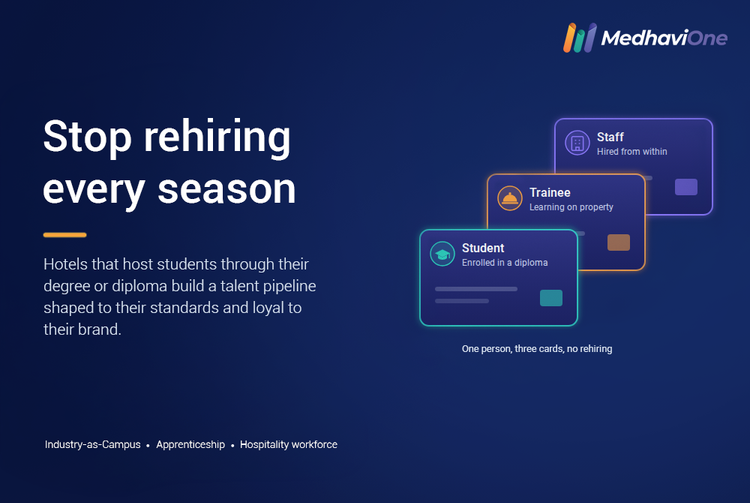
Work-integrated programmes change when the clock starts. When learners spend a substantial part of their degree inside working hotels, rotating across departments and taking on supervised responsibility in their final year, they graduate having already seen peak seasons, shift handovers and service recovery first-hand.
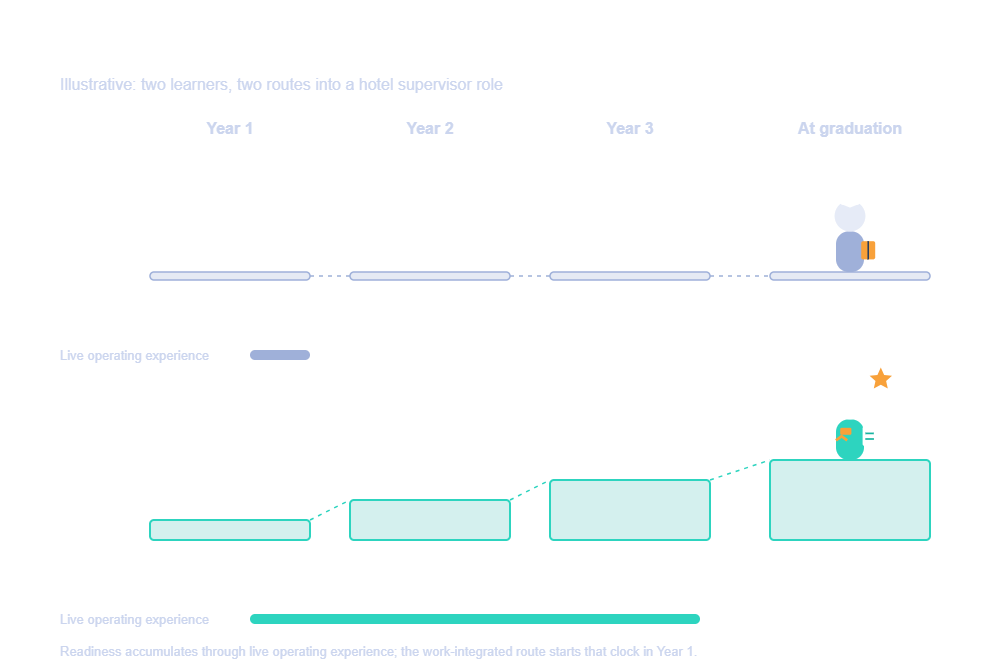
This is the logic behind industry-as-campus models, including the MedhaviOne Academy of Hospitality, where learners train inside partner hotels throughout their programme. No single model will close the shortage on its own. The point is that the leadership pipeline has to begin before the first job, not after the first promotion.
What Hotel Operators Can Do Now
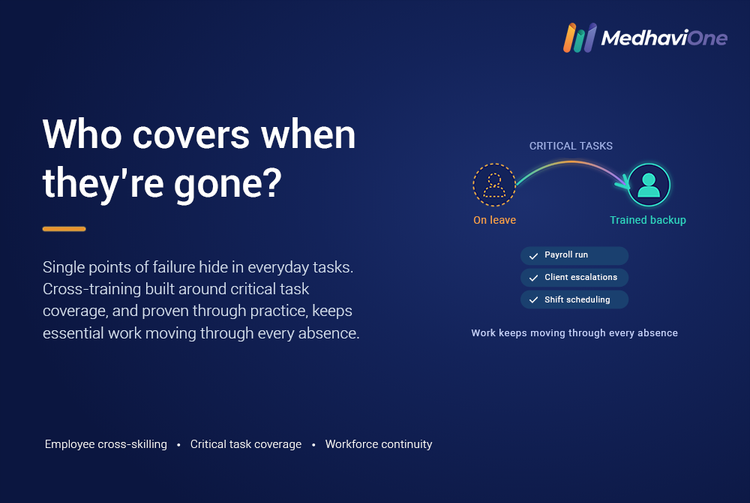
Three moves follow from the report's findings. The first is to treat interns and apprentices as a supervisor pipeline rather than temporary labour, with a defined progression from frontline tasks to shift responsibility. The second is to introduce readiness checkpoints before promotion, so that people step up when they are prepared rather than when a vacancy appears. The third is to invest in training where the hotels are opening. EHL's own recommendation is to embed team-strengthening programmes in tier 2 and tier 3 cities, where service quality depends on locally developed talent (EHL, 2026).
India's hotel boom will be judged by more than the rooms it adds. It will be judged by whether the people running those rooms were prepared for the job before they were given it.
References
Behane, N. (2026) 'The India hospitality market: domestic demand and growth beyond metros', EHL Insights, 26 June.
CBRE Research (2026) Reimagining Indian Tourism. CBRE, September.
EHL (2026) Hospitality Outlook 2026 – India: Scaling Beyond the Metros. EHL Insights white paper. Lausanne: EHL Hospitality Business School.
Rageev R., V. (2026) 'RHG to train 3,000 youth for hotel jobs', Asian Hospitality, 26 October.
Frequently asked questions
It names talent as the sector's most pressing challenge, citing high attrition, uneven middle-management skills and leadership shortages, along with a 20–25% gap in high-quality staff.
Rapid expansion into tier 2 and tier 3 cities, transfers of experienced managers to new properties, high attrition and competition from retail, aviation and technology are thinning the pipeline faster than it can be rebuilt.
Growth is spreading to pilgrimage hubs, leisure and wedding destinations, infrastructure-led emerging cities and regional business centres. Tier 2 and tier 3 markets accounted for nearly half of hotel property transactions in 2024.
Programmes that place learners inside working hotels for much of their training let them build operating experience and supervised responsibility before graduation, so readiness does not start from zero in the first job.
It is an approach that combines academic study with structured, assessed work inside real hotel operations, so practical capability and academic knowledge develop together.