Table of contents8 sections
- The Placement Cell Can't Build What It's Being Asked to Deliver
- Curriculum Is Where It Actually Starts
- Assessment Has to Test Execution
- Industry Exposure Needs to Be Structural
- The Job Market Is Outrunning the Degree Cycle
- Track Employability, Not Just Placement
- What This Means, Depending on Where You Sit
- In Closing
For decades, Higher Education Institutions treated employability as something that happens near graduation. Coursework ends, placement drives begin, employers show up on campus, and the institution reports a percentage.
That model puts employability at the end of education. But employers aren't evaluating a moment,they're evaluating capabilities that form over four years: problem-solving, communication, technology application, learning speed, domain knowledge, execution. And those capabilities have to keep up with roles that are being reshaped by AI and automation while the student is still enrolled.
The real question for leadership isn't whether the university has a placement office. It's whether employability is designed into the institution, or added on afterward.
The Placement Cell Can't Build What It's Being Asked to Deliver
Placement teams operate at the transition point between education and employment — a narrow window, and the wrong one for building capabilities that take years to form. Nobody acquires problem-solving skills in an interview, or workplace communication in a three-day workshop.
Teaching systems deliver knowledge. Placement systems search for jobs. The two rarely talk to each other, and the gap shows up right when it matters most.
The Mercer | Mettl India Graduate Skill Index 2025, which assessed over one million learners across 2,700 campuses, found that 42.6% of graduates applying for jobs were employable for the roles being assessed, down from 44.3% in 2023. AI/ML-specific roles scored higher, at 46.1%. This isn't a vacancy shortage. It's a production problem.
Curriculum Is Where It Actually Starts
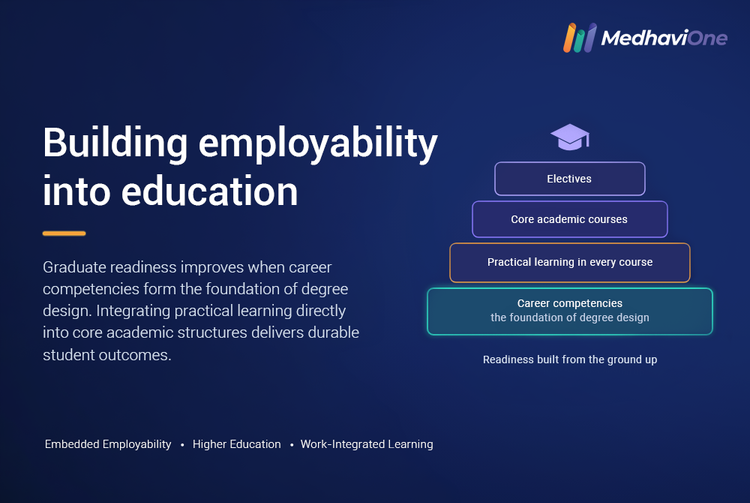
Employability begins with what a course asks a student to do, not what it asks them to remember. A business student studying marketing through a live enterprise brief learns differently than one studying it through a textbook case. A computer science student writing code for a real external user builds different instincts than one submitting to a grading script.
This isn't about turning degrees into vocational training. It's about connecting theory to tasks employers actually assign, because employers don't hire transcripts, they hire people who can execute.
Assessment Has to Test Execution
Students optimise for whatever gets graded. If assessment rewards recall, that's what gets built. If it rewards application and reasoning under real constraints, that's what gets built instead.
Mercer | Mettl's data shows employers weighting logic and learning agility as heavily as technical skill, yet the 2025 assessment put graduate employability in logic and reasoning at just 54.6%, and learning agility at 46%. Neither is built in a placement workshop. Both come from projects, simulations, and live assignments sitting alongside exams throughout the degree, not bolted on at the end.
Industry Exposure Needs to Be Structural
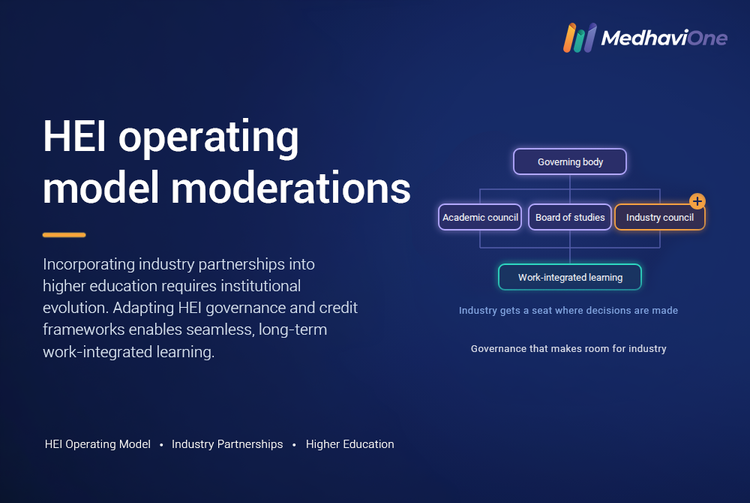
Guest lectures and campus visits aren't industry exposure, they're adjacent to it. Real exposure happens when students encounter actual work as part of the learning process: internships, apprenticeships, enterprise projects, live briefs.
India's apprenticeship numbers show where this is heading. The Ministry of Education reported 4.27 lakh apprentices registered under NATS in FY 2024–25, across software, manufacturing, healthcare, banking, and more. Learning-through-work is becoming infrastructure, not a niche pilot.
An HEI sending 200 students out for internships has created an activity. One that feeds what comes back into curriculum and assessment has built a system.
The Job Market Is Outrunning the Degree Cycle
The WEF's Future of Jobs Report 2025 names AI, robotics, and automation among the forces reshaping Indian roles through 2030, with Data Specialists and AI Specialists among the fastest-growing categories. It also notes that 30% of Indian companies are already hiring by skills rather than degree requirements.
That puts a direct question to institutions: what does a degree signal — completion, or demonstrable capability? Only one of those holds up against skills-based hiring.
Track Employability, Not Just Placement
Most HEIs track one number well — the placement rate — which tells you how a cohort landed, not where the system is working or failing. A better data layer tracks the whole lifecycle: entry skill baselines, curriculum-to-role alignment, internship participation, employer evaluation scores, time-to-employment, salary progression, repeat-hiring rates, and skill gaps flagged by hiring managers after year one.
Placement data reports the past. Employability data tells you where to intervene next.
What This Means, Depending on Where You Sit
For academic leaders, the metric worth tracking isn't how many students are placed — it's how many the university actually built to be placeable.
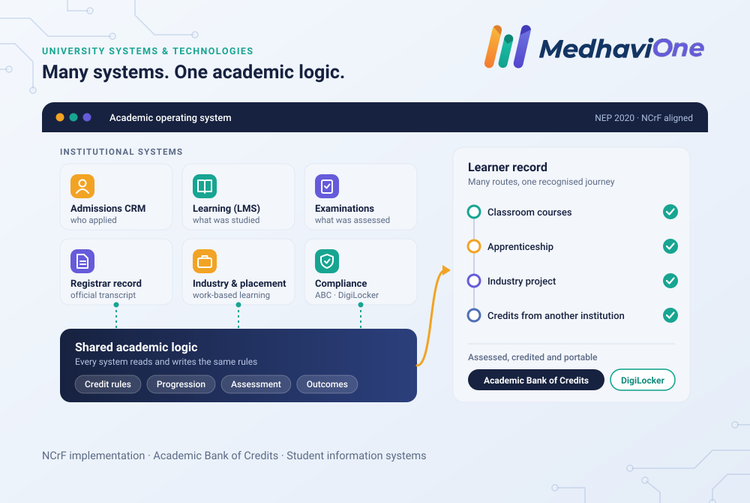
For investors, placement numbers are an output. What predicts durability is whether curriculum, assessment, industry exposure, and outcome tracking function as one connected system.
For employers, this turns the institute from a resume source into a talent-development partner.
For students, employability stops being a semester-seven event and becomes something built in from year one.
In Closing
The future of HEI employability won't be settled at the placement cell. It'll be settled by whether curriculum, assessment, industry exposure, and data are designed to work together from day one — not assembled at the end, once a student is already a jobseeker.
If you're rethinking how employability is architected at your institution — or evaluating one that claims to have solved it — this is the framework worth applying before you look at a single placement number.