Table of contents5 sections
Across the service, retail and manufacturing sectors, employees routinely master complex operational workflows, manage human dynamics, and solve real-time technical problems. While organizations invest heavily in internal learning and development (L&D), this knowledge predominantly stays locked within internal learning management systems and performance appraisals.
To understand why this disconnect persists, we must look at the mechanics of workplace credentialisation, work-integrated learning, and national credit transfer frameworks.
The Structural Disconnect in On-the-Job Learning
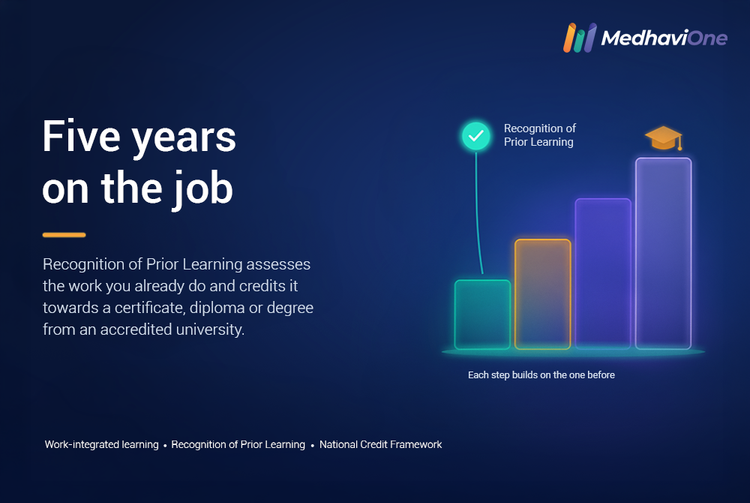
Consider a frontline hospitality employee who spends five years managing shift operations, resolving inventory bottlenecks, and training new hires. By any functional metric, their operational competency has expanded significantly. However, from an institutional and academic standpoint, their formal qualification remains frozen at the level attained prior to employment.
This scenario illustrates a systemic limitation in traditional human capital management. The issue is not a lack of learning; rather, it is a lack of structural articulation between informal learning environments and formal qualification frameworks.
Without recognized credentials:
- Employees face artificial ceilings in career mobility due to rigid degree prerequisites for higher-level managerial roles.
- Employers face challenges in objectively demonstrating workforce competencies to external clients, regulatory bodies, and auditing agencies.
- Higher Education Institutions remain disconnected from the practical, rapidly evolving skill needs of contemporary industries.
The Mechanics: How Work Becomes Academic Credit
Academic credentialisation does not mean awarding degrees simply for years of tenure. Maintaining academic rigor requires that workplace learning be evaluated against defined learning outcomes.
This transition relies on two core educational mechanisms:
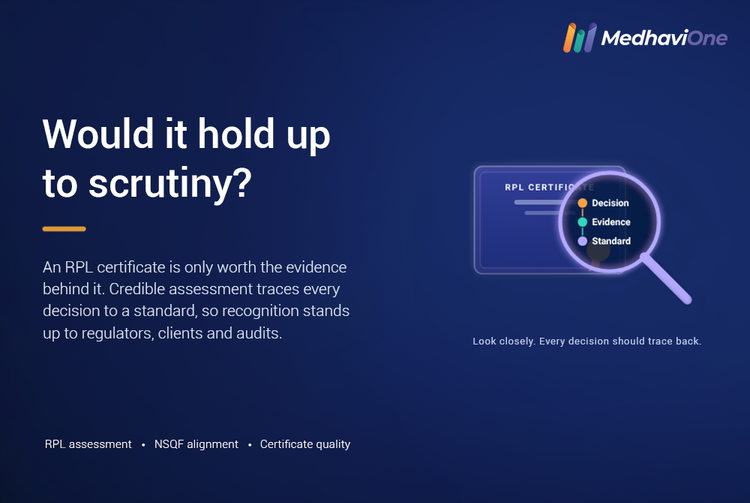
- Recognition of Prior Learning (RPL): A formal evaluation process that assesses knowledge, skills, and competencies acquired through informal or non-formal learning against established occupational standards.
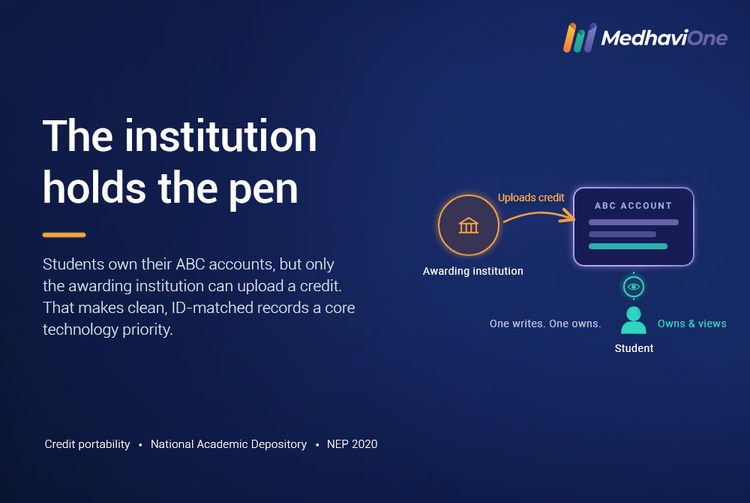
- Integrated Credit Frameworks: Educational policies, such as India's National Credit Framework (NCrF) developed under the National Education Policy (NEP 2020), explicitly recognize that learning occurs both inside and outside the classroom. Under these policies, structured workplace learning can be assigned academic credits mapped directly to national qualification levels.
In a Work-Integrated Learning (WIL) model, the workplace functions as an extended learning laboratory. Theoretical instruction is paired with practical workplace application, validated through structured assessments co-designed by university faculty and industry practitioners.
Key Pedagogical Principle: Experience does not automatically yield academic credit. To maintain institutional integrity, learning must be structured, documented, and assessed by an accredited degree-granting institution.
Organizational and Pedagogical Benefits
When higher education institutions partner with enterprises to formalize on-the-job training, several pedagogical and strategic advantages emerge:
- Contextualized Skill Acquisition: Curriculum design aligns directly with real-world operating environments, bridging the gap between theoretical knowledge and practical execution.
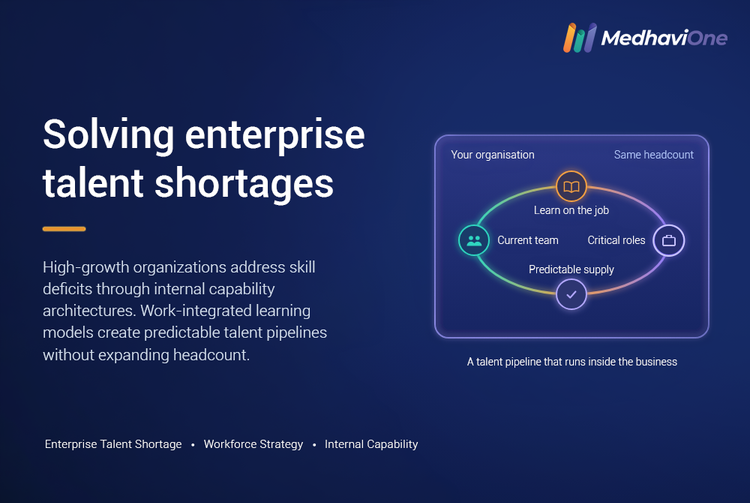
- Continuous Upskilling Without Workforce Displacement: Employees pursue formal diplomas or degrees without taking extended sabbaticals or stepping away from operational duties.
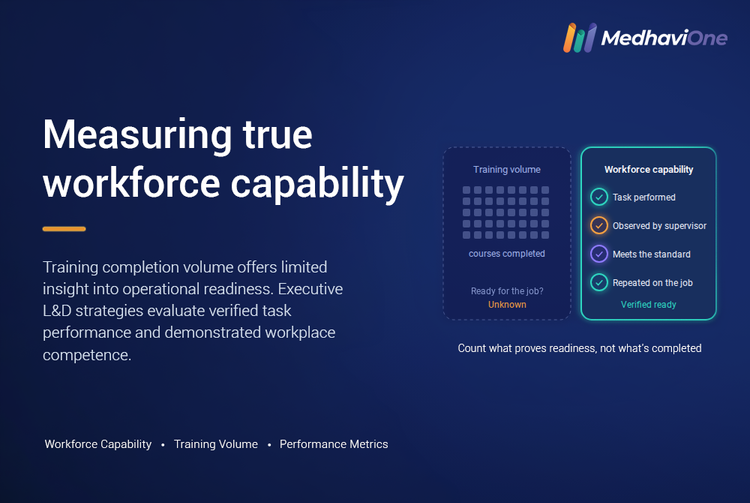
- Auditable Skill Verification: Accredited assessments yield verified transcripts, providing standardized proof of skill distribution across an organization's talent pool.
- Democratized Career Progression: Frontline workers gain structured pathways to higher qualifications, fostering upward mobility and increasing organizational retention.
- Measurable Educational Outcomes: Standardized credit accumulation provides an objective metric for evaluating the efficacy of workforce learning initiatives, moving beyond simple completion metrics.
Real-World Applications in the Indian Higher Education Ecosystem
The integration of higher education and enterprise training is actively advancing within India's vocational education ecosystem.
Institutions like Medhavi Skills University (MSU) have pioneered industry-integrated higher education models grounded in WIL principles. These programs embed degree and diploma curricula directly into enterprise operational workflows:
- Hospitality Sector: Industry partners such as Barbeque Nation have introduced work-integrated degree pathways, allowing restaurant staff to earn accredited qualifications while fulfilling operational roles in culinary and restaurant management.
- Retail & QSR Operations: Enterprise initiatives like Chai Point's "Learn While You Earn" model utilize work-integrated learning structures to provide frontline retail teams with structured pathways toward higher education diplomas and degrees.
These implementations demonstrate a broader shift in modern pedagogy: the workplace is no longer merely where education gets applied, but an accredited environment where education is delivered and recognized.
A Framework for Enterprise-Academic Collaboration
For academic leaders and talent strategists seeking to implement workplace credentialisation, the focus should remain on curriculum alignment rather than off-the-shelf training:
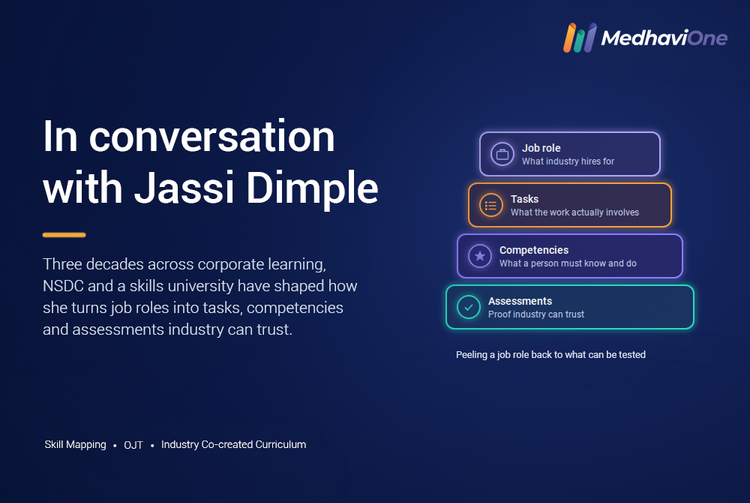
- Competency Mapping: Map internal role responsibilities and training modules against national qualification frameworks and academic learning outcomes.
- Establish RPL Pathways: Identify existing skills within the frontline workforce that can be evaluated for formal credit exemptions.
- Co-Design Curricula: Partner with accredited higher education institutions to blend technical, job-specific skills with foundational academic coursework (e.g., critical thinking, management fundamentals, and digital literacy).
- Dual Assessment Systems: Implement hybrid evaluation methods combining workplace supervisor assessments with university academic evaluations.
Rethinking the relationship between employment and higher education transforms everyday workplace tasks into recognized educational progress, supporting lifelong learning for employees while constructing resilient talent pipelines for the enterprise.