Table of contents6 sections
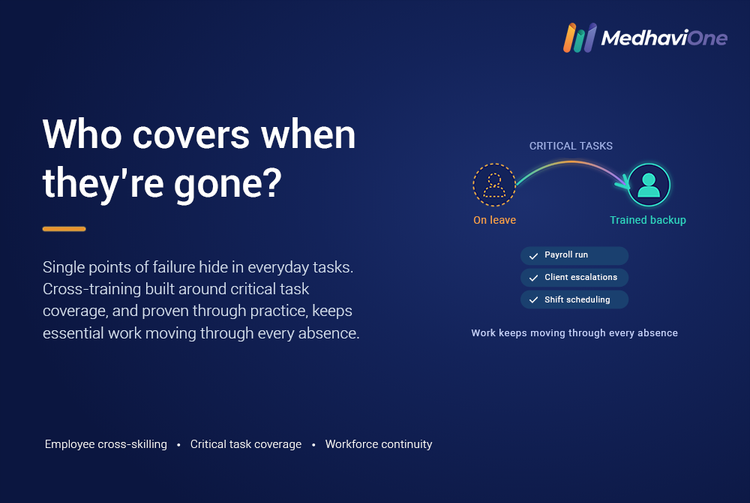
Most organisations can name the people who keep critical work moving. Far fewer can say what happens to that work when those people are on leave, in transition or gone. Cross-training is the usual answer, yet it is often designed around people and job titles rather than around the tasks that must never stop. This article summarises the problem and offers two takeaways for designing cross-training around critical task coverage.
Why Single Points of Failure Hide in Everyday Work
The problem is rarely a missing department. It is a single task, such as a month-end close, a line changeover or an escalation route, that only one person performs reliably. Practitioners call this a single point of failure and measure it through coverage: the number of people who can perform a task independently (Fabrico, 2026). Contractors do not change the arithmetic. If an outside specialist holds the only capability, coverage is still one.
The exposure is not abstract. An Aon survey reported India Inc attrition at 16.2% in 2025, down from 18.7% in 2023 (Sharma, 2026). Even at that calmer level, roughly one employee in six leaves in a year. On average, a task with a coverage of one therefore carries about a one-in-six chance each year of losing its only performer, before leave, illness or promotion are counted.
Cross-training is the standard remedy, but it tends to fail in two ways. It starts too late, often after a resignation, when the leaver has little incentive to teach (SkillsYouNeed, n.d.). And it is confused with job rotation, which mainly broadens experience, whereas cross-training exists to provide cover (Everhour, 2026). A programme that feels developmental can still leave the riskiest tasks exactly as exposed as before.
First, Map Coverage at Task Level and Rank It by Criticality
The first takeaway is to start from the work, not the organisation chart. List the tasks in a function, then ask two questions of each: what happens if it stops for a week, and how many people can perform it without help?
The answers sort tasks into four groups. A critical task with a coverage of one is the immediate priority, and Fabrico's guidance treats it as a present risk rather than a future training item (Fabrico, 2026). Critical tasks that are already well covered need periodic checks. Less critical tasks can remain single-covered, provided that is a documented decision rather than a surprise during an incident (SkillsYouNeed, n.d.). Less critical tasks that are already covered need no extra training.
Depth should then follow criticality. A workable target is to be "two deep on the critical few": a second and third person on the tasks that would stop everything (SkillsYouNeed, n.d.), including at least one who can teach the task to others (Fabrico, 2026).
Cross-training is also not a licence to flatten expertise. Spreading everyone thinly can erode the deep skill that certain specialists hold (SkillsYouNeed, n.d.). The aim is depth where it matters and cover where it counts.
Second, Treat a Backup as Real Only When It Has Been Proven
The second takeaway is that a name in a matrix is a claim, not a capability. A name beside a task that its holder has not performed for a long time tells you who was once trained, not who can step in today (SkillsYouNeed, n.d.). Three habits make cover verifiable.
Prove competence through practice. Competence means performing to a recognised standard, and attending a session is not enough (SkillsYouNeed, n.d.). Have the expert narrate a routine job and record the decision points, then watch the learner perform it, stepping in only where needed. Agree in advance what the learner can decide alone and when supervision ends.
Date every sign-off. A skill level without a date is an outdated claim, and Fabrico suggests that someone who has not performed a task for about 18 months should no longer count as independent (Fabrico, 2026). Infrequent, complex or safety-critical tasks need scheduled refreshers, because currency is the first thing to decay (SkillsYouNeed, n.d.).
Protect the people doing the covering. Training takes time from both learners and trainers, and unchanged workloads lead to overload. When several people can do a task, ownership can also blur (Everhour, 2026). Name one accountable owner per task and adjust workloads. Then track three measures: coverage (critical tasks with at least one trained backup), competency (backups completing the task unaided) and continuity (work flowing through absences) (Everhour, 2026).
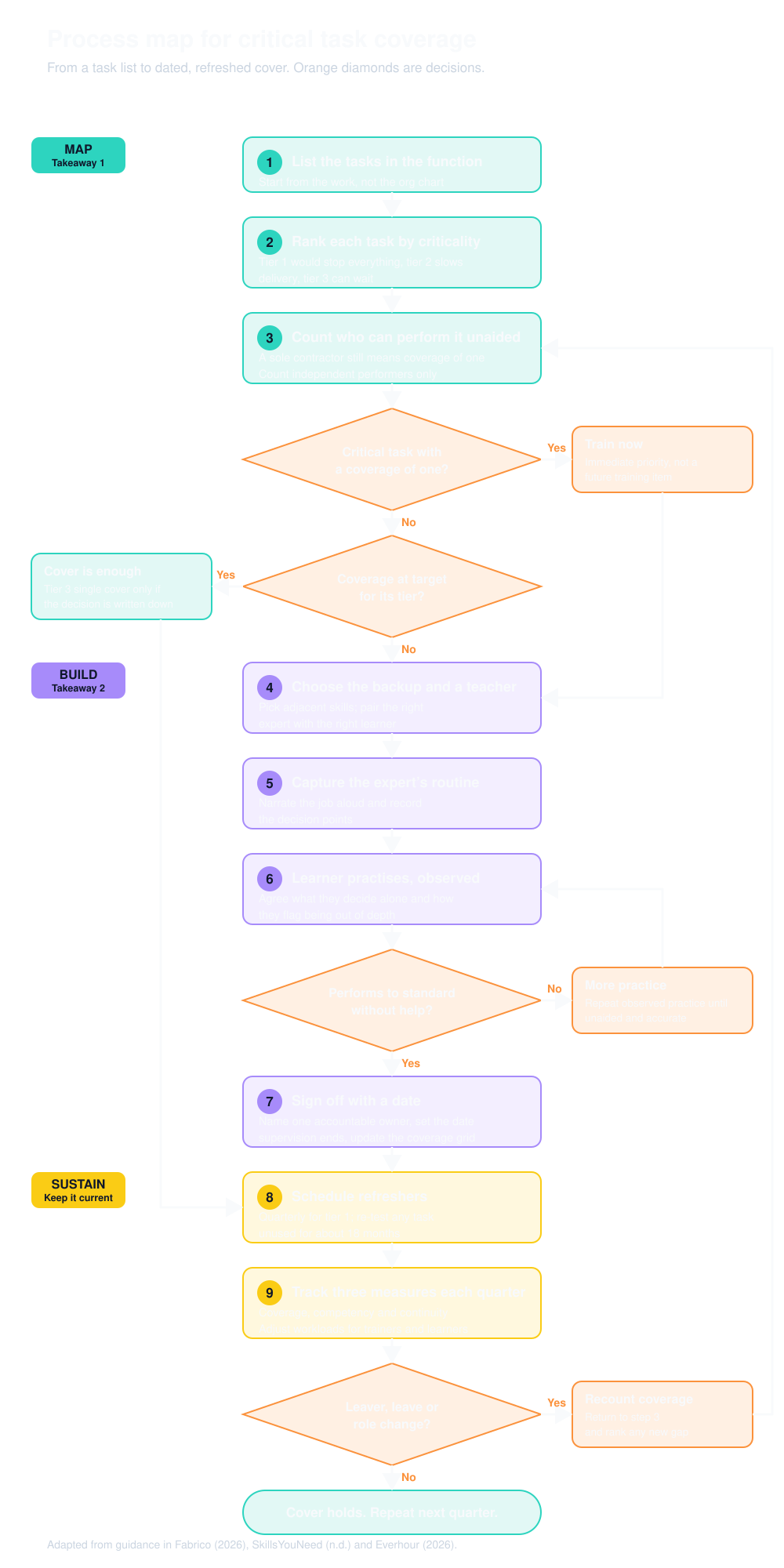
The process map below joins both takeaways into one working sequence, including the loops that keep cover current.
A simple grid keeps these habits visible to managers. In the sample entries below, tier 1 tasks would stop everything, tier 2 tasks would slow delivery and tier 3 tasks can wait.
What This Means for Enterprise Capability Building
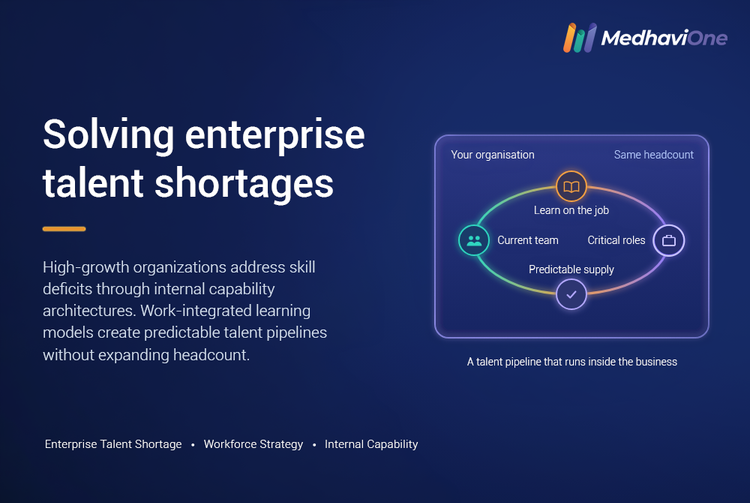
For enterprise leaders, the useful question is not how many training sessions were run, but which critical tasks still have a coverage of one, and since when. Answering it takes task-level mapping, an honest view of which internal candidates sit closest to each gap, and structured skill bridges that end in observed performance. That sequence is where role and capability mapping, upskilling and work-integrated learning, the areas MedhaviOne Enterprise supports, do their most practical work. Resilience is not the absence of key people. It is enough proven cover that no single person is the only answer.
References
Everhour (2026) 'Cross-training employees: benefits, examples, and best practices', Everhour blog, 20 October (last modified 12 November 2026).
Fabrico (2026) 'The maintenance skills matrix: how to build one that gets used', Fabrico blog, 27 August (updated 26 October 2026).
Sharma, M. (2026) 'Lowest in five years: what 16.2% attrition really signals for 2026', Business Today, 2 March. Reporting an Aon survey of India Inc attrition.
SkillsYouNeed (n.d.) 'Cross-training for operational resilience: building teams without single points of skill failure', SkillsYouNeed.
Frequently asked questions
It is the number of people who can perform a critical task independently. A coverage of one is a single point of failure, so cross-training should target those tasks first.
A workable target is a second and third person for tasks that would stop everything, including one who can teach the task. Lower-priority tasks can stay single-covered if that is a documented decision.
Cross-training builds the ability to cover tasks, mainly for continuity. Job rotation moves people between roles, mainly to broaden their experience.
Date each sign-off, schedule refreshers for infrequent tasks and check that backups complete the task unaided. A level with no date, or one unused for about 18 months, should not count as independent cover.