Table of contents8 sections
- From the Army to the Classroom: How Competency Mapping Evolved
- How to Skill Map a Job Role, Step by Step
- One Skill Map, Five Readers
- Assessing Behavioural Competencies Without a Written Test
- AI and the Shrinking Shelf-Life of Skills
- Co-Creating Skill Maps with Industry Partners
- Mapping and Assessing Skills in OJT and Apprenticeships
- The Ultimate Benchmark of a Skill-Mapped Programme
Skill mapping is often filed away as an HR template. For Jassi Dimple, it is the one document that decides whether training, assessment and hiring pull in the same direction. As Senior Vice President – Industry Integrated Education at Medhavi Skills University, she has spent three decades across corporate learning at ICICI Prudential Life Insurance, the National Skill Development Corporation (NSDC), and as co-founder of PROGILENCE Capability Development. I spoke with her about how the practice has evolved, how a job role is mapped well, and what a skill-mapped education should ultimately serve. Responses have been lightly edited for length and clarity.
From the Army to the Classroom: How Competency Mapping Evolved
You have worked in L&D, at NSDC, in your own venture and now at a university. How has competency mapping evolved over these three decades?
Competency mapping is an old tool that started with the army. It is an HR and L&D tool, but above all it is a job tool. It is used wherever people must become productive quickly and wherever the margin for error is small.
It began in the army. You analyse the job role, write down every task, and for each task identify the minimum knowledge needed. Then you guide the attitude and have people practise until they get it right. Corporates adopted it because it is efficient: you learn by doing, so you are productive from day one.
Classrooms worked differently. They built understanding and theory. An academic could explain a job better than the person doing it, yet be unable to do it. For a long time we kept the planners and the doers apart. As we understood that everyone can learn, that separation stopped making sense. Doers who know the principles avoid mistakes and take initiative. Planners who know the ground make plans that actually work.
Where did skilling enter that story?
Education became premium, so the industry began asking for graduates. But graduates arrived without practical ability, often trained on equipment the industry no longer used. Employers said they had to train them for a year or two, and then lost them. Around the mid-2000s the conversation changed. NSDC and the Sector Skill Councils came in, and "vocational training" became "skills". Each sector mapped its job roles with industry, starting with the high-volume roles, and wrote Qualification Packs. Industry has always done this exercise. Now it is being done at a national scale.
How to Skill Map a Job Role, Step by Step
Take a real manufacturing role. How do you turn it into granular learning outcomes that carry both academic depth and practical use?
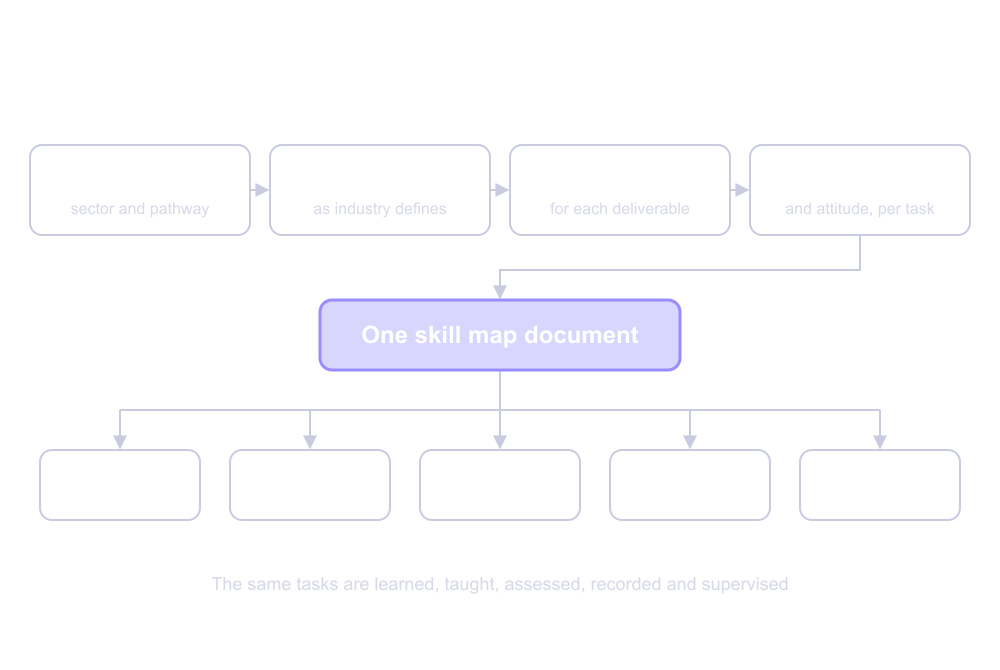
First, place the job role in context: its sector, its occupation and its progression pathway. What should a person already know before entering it, and which roles can they reach next? Then ask what the key deliverables are, and the best people to ask are always from industry.
Take a CNC machinist, who loads a program into a computer-controlled machine that cuts a part with a specific tool. The machinist is given a drawing, a timeline and raw material. Four deliverables are specific to the role. Three more apply to anyone in a factory.
Under each deliverable, you write down the tasks. Then you write what the person must know and understand, and how they must behave. That is skill mapping. It is not just a list of tasks.
One Skill Map, Five Readers
Who is this document really written for?
It is the base document for the trainer. But give it to someone already on the job, with no training at all, and they will still know every little thing they must learn. They will go around asking for it. The assessor uses the same document. So do HR and the supervisor.
When the trainee, trainer, assessor, HR and supervisor all work from one document, how can you not get smooth, efficient performance? A supervisor may help write it, but its readers go all the way down to the trainee. So the language must be simple, clear and complete, free of jargon. Unfortunately, people often write it in a hurry. A job role is broken down step by step into one document, which every stakeholder then works from.
Assessing Behavioural Competencies Without a Written Test
Behaviour and attitude are the hardest to pin down. How do you map and assess problem solving, adaptability or workplace communication within a formal rubric?
Pick the skill in its context. For a CNC machinist, attention to detail matters enormously. I would never ask what attention to detail means. I would hand over a drawing, ask for the requirements, and see what they miss. Or I would give a machined component with its drawing and ask them to find a very fine error. In skilling, the assessment has to be skill-based too.
For behaviour under pressure, you create pressure. One interviewer gave me three simple riddles, with a ticking clock, a warning bell and a final bell. I could normally crack them easily. The clock was the test. Done properly, learning and assessing skills is engaging. Nobody sits there yawning.
The exchange reminded me of an editorial interview early in my career, when I was handed my own error-strewn CV and asked to find its mistakes. I found eleven. It was a skill-based assessment before I knew the term.
AI and the Shrinking Shelf-Life of Skills
AI-enabled automation has shortened the half-life of technical skills. How often must a skills university audit its skill maps to avoid obsolete curricula?
A curriculum is many documents stitched together. It starts with what the programme wants to achieve, then programme outcomes: what students will be able to do, know and value by the end. Those upper layers can be reviewed every two or three years.
But change now reaches nearly every activity. If I teach someone to write a letter, I must now also teach them to write it with AI. I still teach the basics, but I make room for the latest techniques. Otherwise my students lag behind.
So the curriculum department should check, every year before a session begins, for new technologies and new job roles. Roles are being defined by the month. Even that is not enough. A teacher preparing a lesson should check what is new that day. My teachers read the newspaper each morning and tied every article to their subject. That habit still matters.
Co-Creating Skill Maps with Industry Partners
How actively do enterprise partners co-create skill maps and rubrics with you, rather than simply being consulted?
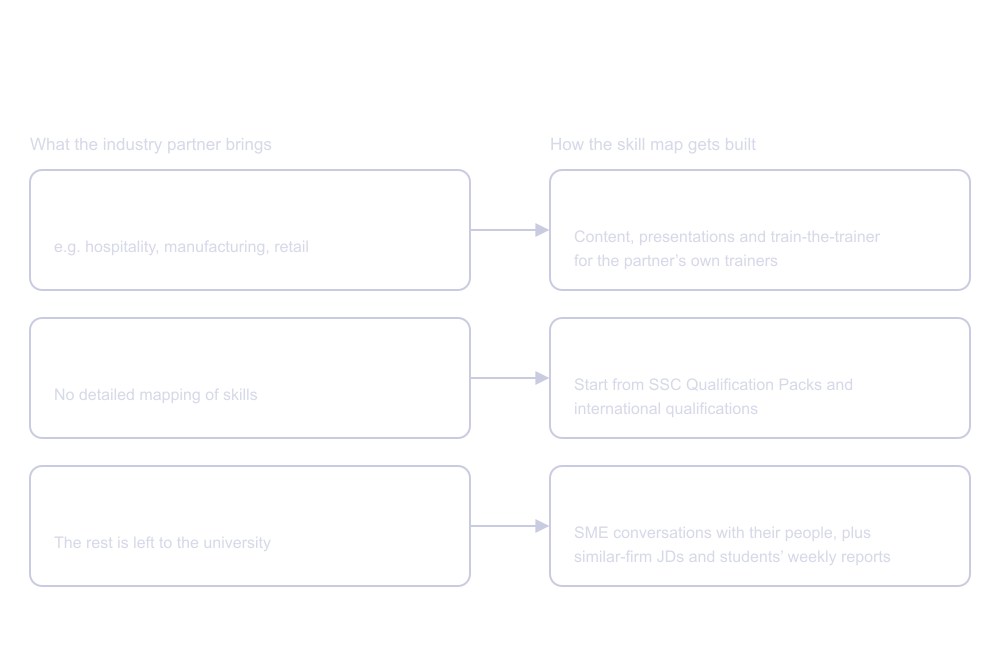
It depends on how badly they need the skill and how hard it is to find. Some partners, in hospitality and manufacturing, hand us the job roles and outcomes. In retail, some asked us to build the content and train their trainers, who then teach that portion.
Others bring a role and a few outcomes. We study the Sector Skill Councils' Qualification Packs and international qualifications, draft a skill map and let them refine it. A third group says: take our students for on-the-job training, the rest is your concern. Then we ask, at the very least, to map the job role through conversations between their people and our subject experts. Whatever the partner provides, the outcome is the same: a mapped job role before training begins.
Mapping and Assessing Skills in OJT and Apprenticeships
When students are on an apprenticeship or on-the-job training, you control less. How do you map, monitor and standardise what they learn?
In an apprenticeship we are in control. The job role is mapped and a qualification created before learners go in. Internships and some OJT are different, because the employer is focused on productivity. There, we study the sector, its products and the entry-level occupations, and draw out the competencies. We even use job descriptions from similar firms. The aim is to understand the role in as much detail as we can.
Assessment follows the same map. Students receive the OJT syllabus. Formatively, they upload what they learn, work with our trainers and file a weekly report that faculty mark. We prefer the industry supervisor to evaluate them; otherwise, faculty take the supervisor's feedback and cross-check through a viva. An external skill test and viva at the end of term use the same competencies.
Those competencies grow each year. In year one, a student works as an assistant and is assessed on basics such as punctuality, hygiene, courtesy and communicating through the hierarchy, plus entry-level technical skills. In year two, they perform the full role. By year three, they should be ready to teach or supervise others.
The Ultimate Benchmark of a Skill-Mapped Programme
After three decades in skill development, what is the ultimate benchmark of a successful skill-mapped higher education programme?
Skilling prepares you for a livelihood. Education cannot stop there. An educated person should live a meaningful life, contribute to society, and act as a good citizen of the country and of the world.
As a skills university, about 60% of our curriculum is skilling, and that means livelihood with dignity, not only a job. The other 40% is about being an effective human being, a good member of society, and a national and global citizen. The ideal is a convocation full of confident graduates who know what they want, and alumni who have made it.
There is a caution too. Academia once led industry; today we look to industry for direction. Let us catch up quickly, then lead again, by researching what the world will need five, ten and fifteen years from now. B.Voc programmes already make vocational study aspirational, preparing students for hundreds of job roles beyond the familiar ten or twelve careers. The next step is to decide the future of each sector together with industry, and build it into the curriculum.
It was the right note to end on. A skill map is only as good as the future it is drawn for.