Table of contents6 sections
- Why Talent Shortage Is a Structural Problem, Not a Hiring Problem
- What "End-to-End Workforce Capability" Really Means
- How Sectoral Training Reduces Attrition
- Case Study Model: Retail, Healthcare and Logistics Enterprises
- Building a 3-Year Capability Roadmap for Your Organisation
- Frequently asked questions
India is producing more job-ready graduates than ever. According to the India Skills Report 2025, graduate employability reached 54.81%, up from 51.25% in 2024 and around 46% in 2020.
Yet GCCs, technology firms and advanced manufacturers still struggle to fill roles in AI engineering, cloud architecture and automation. The talent shortage in India is no longer about the number of candidates. It is about specific capabilities that the market cannot supply fast enough.
India's fastest-growing companies are responding by asking a different question. Instead of "Whom can we hire?", they ask "Who in our workforce is closest to this role, and what stands in the way?"
Why Talent Shortage Is a Structural Problem, Not a Hiring Problem
A hiring problem can be solved with a wider search or a better offer. India's workforce skill gap has persisted despite both, because the cause is structural.
Job requirements now change faster than education systems can respond. Nasscom estimated India's digital talent demand–supply gap at 25–27% in its December 2023 report India: The Tech Talent Nation, and projected it would widen to 28–29% by 2028.
When many employers compete for the same scarce specialists, costs and vacancy periods rise for everyone. Even a successful hire provides only today's skill set. As the role evolves, the capability gap reopens.
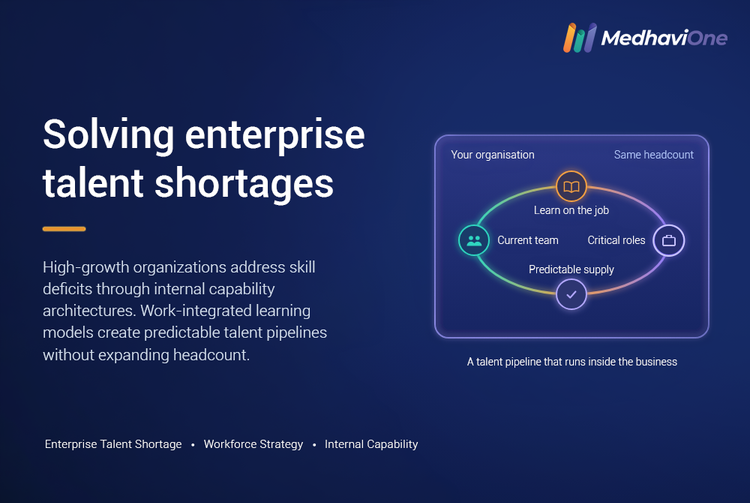
The lasting answer lies inside the organisation. Employees who already understand its customers, systems and culture are often the fastest route to the capability it needs next.
What "End-to-End Workforce Capability" Really Means
End-to-end capability is a system, not a training calendar. It identifies a gap, finds the closest internal candidate, builds the missing skills and proves the result on the job. Four practices make it work.
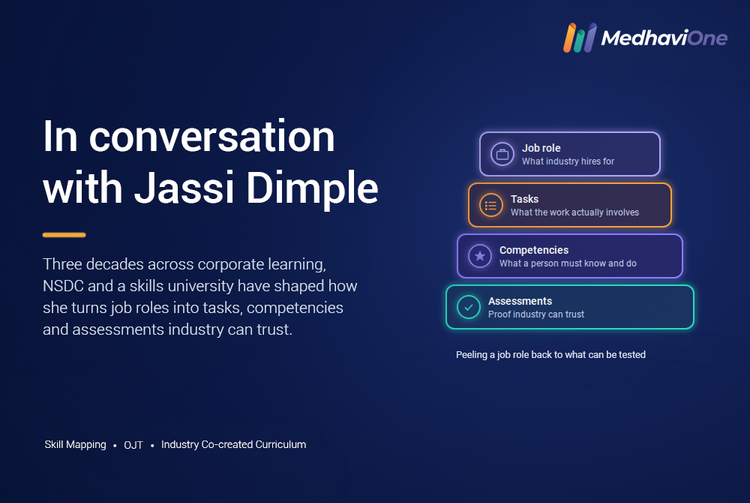
Break roles into tasks. Leading L&D teams split each critical role into 20–30 discrete tasks. They separate what can be automated, what an adjacent employee already does and what needs new skill. Training then targets only the real gap, often through 8–12-week skill bridges.
Map skills, not job titles. IT services firms, GCCs and BFSI organisations increasingly record capabilities in their HCM platforms rather than static designations. When a cloud security role opens, they can surface people with network engineering or database experience who are closest to readiness.
Use the public skilling ecosystem correctly. NSDC, Skill India Digital and the PM-SETU scheme for industry-linked ITI upgrading create partnership routes for employers. CSR has a firm boundary here: Ministry of Corporate Affairs rules exclude activities that benefit only a company's own employees. CSR can fund community and ITI skilling that builds the future talent pipeline, not internal upskilling.
Develop the supervisory layer. In manufacturing, supply chain and logistics, digital change often stalls with supervisors. Technical literacy, coaching and change management at this level let Industry 4.0 tools take hold without replacing experienced operational leaders.
How Sectoral Training Reduces Attrition
People often leave when growth looks faster elsewhere. Training tied to a visible next role changes that calculation. In LinkedIn's Workplace Learning Report (2018), 94% of employees said they would stay longer at a company that invested in their learning.
Sector-specific training adds a second benefit: confidence in the current job. In healthcare, retail and logistics, early exits often follow a difficult first few months. Learning built around real workflows, such as ward protocols, peak-hour store operations or warehouse systems, helps new and existing staff feel ready.
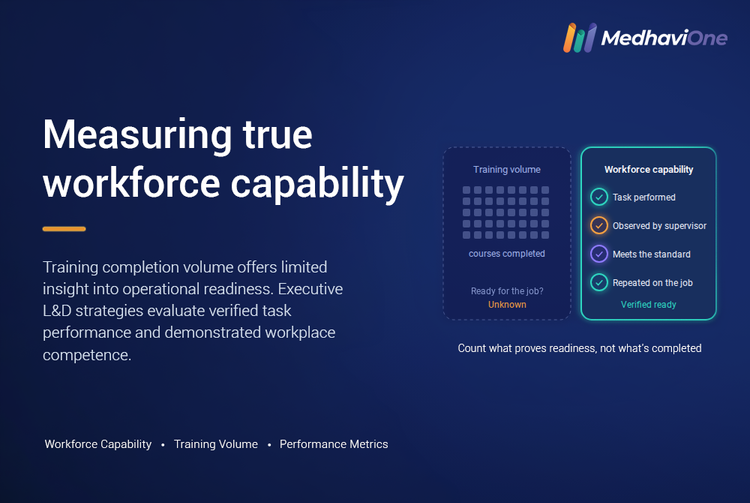
Training is not a cure on its own. Pay, management and workload still matter. Employers should compare 12-month retention of programme participants with similar employees, rather than treating completion rates or certificates as proof of impact.
Case Study Model: Retail, Healthcare and Logistics Enterprises
The model below illustrates how enterprises in three sectors can apply these practices. It is a composite, not an account of a named client.
In each case, the best candidate for the next role is usually one level below it. What is missing is a structured bridge and a clear way to measure it.
Building a 3-Year Capability Roadmap for Your Organisation
A phased roadmap lets leadership test the approach before scaling it.
Year 1: Diagnose and pilot. Choose two or three roles with the longest vacancy periods. Break them into tasks, assess internal candidates and run one targeted skill bridge per role. Record baseline costs and time-to-fill for comparison.
Year 2: Scale what works. Extend successful pathways across a business unit. Build the skills inventory into the HCM platform, develop supervisors and track internal moves against business outcomes.
Year 3: Embed and extend. Link capability planning to workforce forecasts and succession plans. Add credit-bearing pathways and community skilling partnerships, and reserve external hiring for gaps no internal route can close.
Three measures show whether the roadmap is working: internal fill rate for critical roles, time to competent performance, and 12-month retention of participants.
MedhaviOne Enterprise Solutions supports this journey through role and capability mapping, upskilling, reskilling, work-integrated education and Recognition of Prior Learning. The talent your business needs next may already be on its payroll.
Frequently asked questions
Sectors where roles change quickly or frontline teams are large gain most, including IT services, GCCs, BFSI, manufacturing, retail, healthcare and logistics.
The key measures are internal fill rate for critical roles, time to competent performance, and 12-month retention of participants compared with similar employees.
L&D typically delivers courses. Enterprise capability solutions start from business gaps, map them to roles and tasks, and build pathways that end in measurable job performance.
It ties new skills to live work and a visible next role inside the company. Employees can see their growth where they are, which removes a common reason to leave.