Table of contents8 sections
- Why a Content-First LMS Struggles With Work-Integrated Learning
- What a Learning Record Has to Capture
- Library or Record: Where the Two Models Part Ways
- How Much of the Apprenticeship Grade Sits Outside the LMS
- Five Questions to Ask of Your Academic Technology
- What Records Mean for Institutions in the ABC Era
- References
- Frequently asked questions
A library holds what an institution knows. A record holds what a learner can do. Most learning management systems (LMS) in Indian higher education were built as libraries: they store lectures, readings and quizzes, and they do it well. Work-integrated programmes ask for something else. When a student spends one to three semesters inside an employer's premises, the learning that counts happens off the platform, and the evidence arrives as attendance sheets, supervisor ratings, daily diaries and site-visit notes.
Having worked across corporate settings and universities, I have seen the same pattern repeat: the record that matters sits in a different place from the system built to hold it. The question for institutions is no longer whether they have an LMS. It is whether their academic technology can show what a learner did, where, and to what standard.
Why a Content-First LMS Struggles With Work-Integrated Learning
The National Education Policy 2020 asks institutions to experiment with models of apprenticeship (MoE, 2020). The University Grants Commission's 2025 guidelines for Apprenticeship Embedded Degree Programmes (AEDP) turn that into practice, and they read less like a teaching manual and more like a records specification (UGC, 2025). Read them closely and a pattern appears.
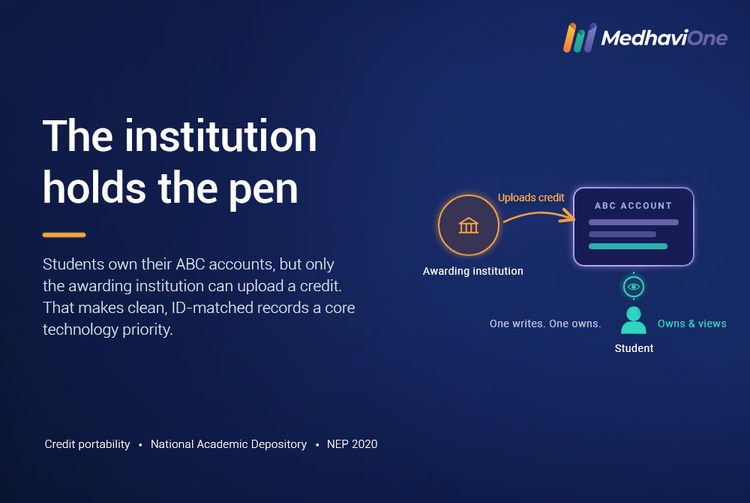
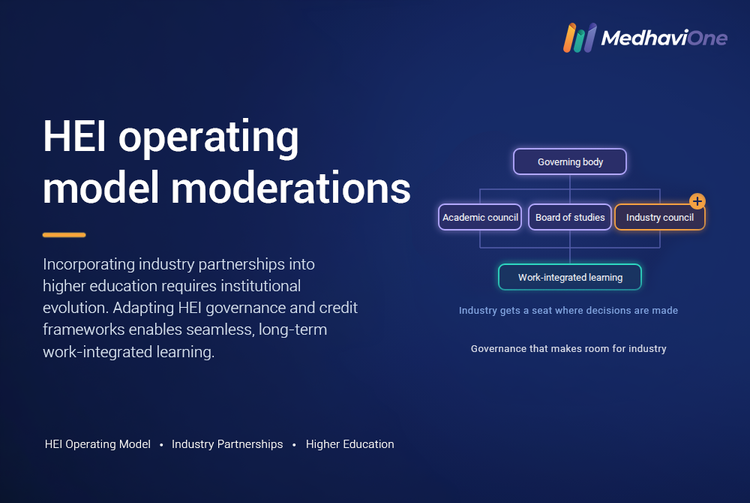
The apprenticeship must take place at the workplace, not within the university's academic establishment. It requires a tripartite agreement among the institution, the employer and the student. It is assessed by the employer, by a faculty mentor on site visits and through a seminar and viva-voce. Transcripts must name the credits earned through apprenticeship and the establishment where it was undertaken, and the institution must upload those credits to the Academic Bank of Credits (ABC).
None of these is a content-delivery task. Each one is a records task. When the LMS cannot hold an agreement, an employer's rating or a mentor's visit note against an individual learner, the work moves into spreadsheets, email threads and paper files. The institution then rebuilds the record at the end of the semester, exactly when credits and transcripts are due.
What a Learning Record Has to Capture
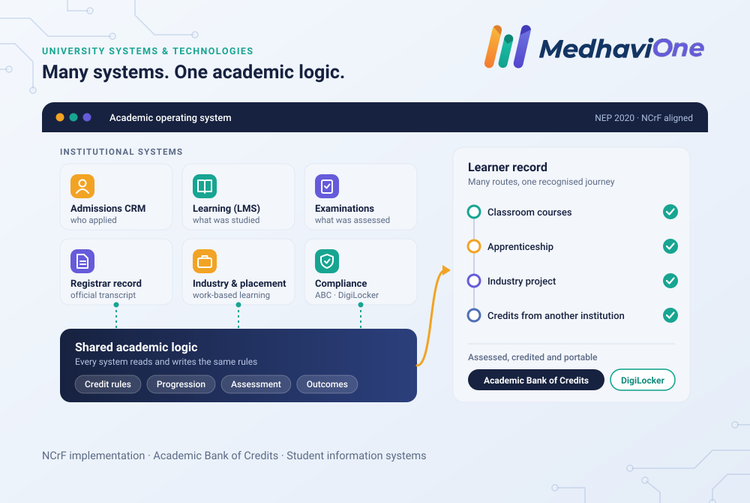
Between the classroom and the workplace, evidence of learning is created in five places, and the record must serve three obligations that the guidelines spell out (UGC, 2025).
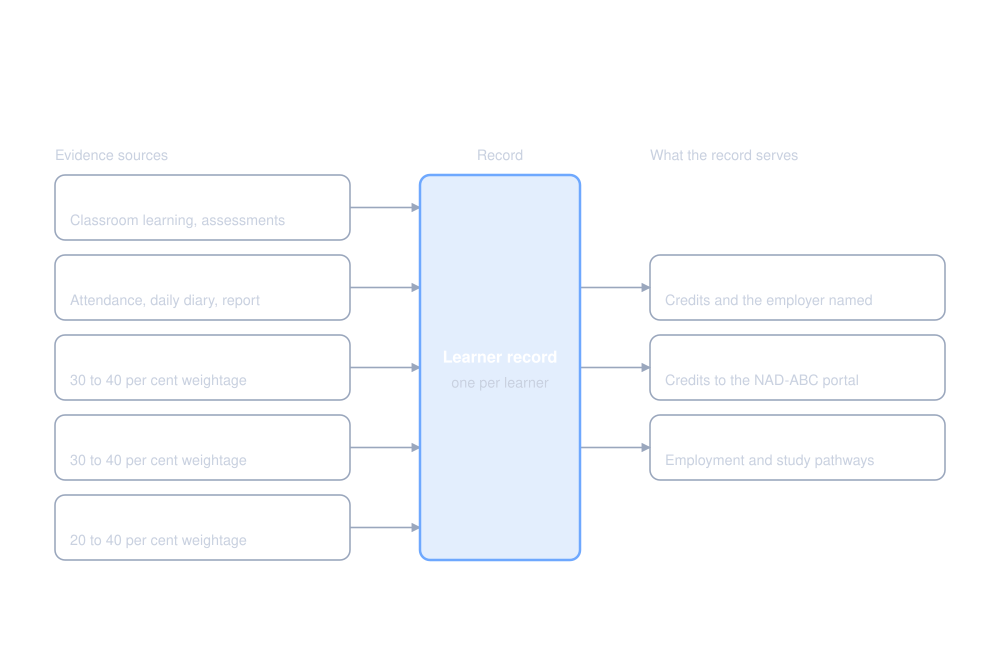
Every arrow into the record starts at a different desk, and every arrow out is a credential or compliance duty. A single learner record can answer all of them from one place. Five separate files cannot.
Library or Record: Where the Two Models Part Ways
The difference is not a matter of features. It is a matter of what the system treats as its basic unit, and who is allowed to add to it.
How Much of the Apprenticeship Grade Sits Outside the LMS
The guidelines let institutions and employers agree the weightage within set bands, so the split can vary (UGC, 2025).
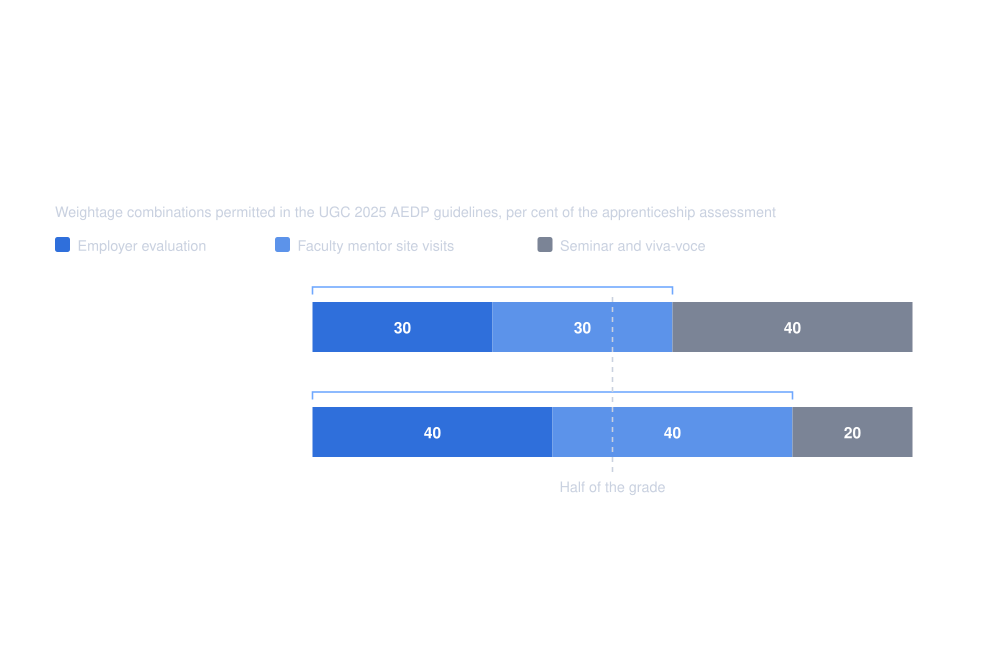
UGC AEDP guidelines 2025, section 12 · weightage bands for the apprenticeship assessment
The employer evaluation and the faculty mentor's site visits carry 30 to 40 per cent each, so together they decide at least 60 per cent and as much as 80 per cent of the apprenticeship assessment. Even in the lightest case, more than half the grade rests on evidence that a lecture-style platform never sees.
Five Questions to Ask of Your Academic Technology
Before the next academic cycle, a vice-chancellor, registrar or dean of industry integration can test a platform against the guidelines themselves.
- Can it hold the paperwork against the individual learner? The tripartite agreement, the apprenticeship plan and attendance records should sit with the student's record, not in a shared folder.
- Can an employer supervisor contribute in minutes? Evaluation by the employer carries real weight, so it has to be easy for a shift lead or store manager to give.
- Can a mentor see a whole cohort at a glance? The guidelines expect one faculty member to mentor and evaluate at least 20 to 30 apprentices (UGC, 2025). A mentor needs one view, not thirty email chains.
- Does the transcript show apprenticeship credits and the employer, and can the credits reach ABC? Both are explicit expectations in the guidelines.
- Can you follow graduates for a year after completion? Institutions are expected to track the employment and education pathways of pass-outs for at least one year (UGC, 2025).
What Records Mean for Institutions in the ABC Era
The national direction is toward portable, verifiable records. By 2 July 2026, 26.35 crore verified APAAR IDs had been generated, and the UGC had asked every higher education institution to upload credit data for examinations held in 2025 to the NAD-ABC portal by 30 June 2026 (PIB, 2026). A learner's evidence is becoming something other institutions and employers will read.
That raises the standard for work-integrated programmes. A credit earned in a warehouse, a hospital ward or a hotel kitchen must be as legible to the next institution as one earned in a lecture hall. This is why unified platforms, such as MedhaviOne's University Systems & Technologies (MUST), treat the LMS as one component alongside the student information system, admissions and fee systems, all feeding a single learner record.
The better test of academic technology in a work-integrated programme is not how much it holds. It is how little the institution has to reconstruct.
References
Ministry of Education (2020) National Education Policy 2020. New Delhi: Government of India.
Press Information Bureau (2026) Academic Bank of Credits and APAAR: Building India's lifelong learning ecosystem. Factsheet, 4 July 2026. New Delhi: Government of India.
University Grants Commission (2025) Guidelines for Higher Educational Institutions to offer Apprenticeship Embedded Degree Programme (AEDP). New Delhi: University Grants Commission.
Frequently asked questions
It can support the classroom component well. The workplace component needs a system that also holds the tripartite agreement, attendance, employer and mentor evaluations, and credits for transcripts and ABC, which a content-first LMS usually does not.
Credits are calculated by duration instead of notional hours. A three-month apprenticeship earns 10 credits, subject to assessment against the defined learning outcomes (UGC, 2025).
For a three-year undergraduate programme, between one and three semesters. For a four-year programme, between two and four semesters. Each spell must be at least one complete semester, and the total duration of the programme does not change (UGC, 2025).
Three parties share the assessment: the employer (30 to 40 per cent weightage), a faculty mentor on site visits (30 to 40 per cent) and a seminar with viva-voce at the institution (20 to 40 per cent) (UGC, 2025).
An LMS delivers and tracks learning activity such as content, assignments and quizzes. A student information system holds the formal student record, including admission, enrolment, credits and fees. Work-integrated programmes need both to feed one learner record.