Table of contents9 sections
- Why Apprentice Intake Is Usually Planned Backwards
- The Five-Step Method for Calculating Supervision Capacity
- A Worked Example: From 360 Hours to 20 Places
- Apply the Ratio Ceiling for Each Experience Level
- Test Your Capacity Against the Intake Band
- What to Measure After Intake
- Ask How Many You Can Teach Well
- References
- Frequently asked questions
Most apprenticeship plans begin with a headcount target. Few begin with the number of hours that experienced people can genuinely give to a learner. That gap, between the places a business wants to fill and the supervision it can actually provide, is where apprenticeship quality is won or lost. This guide shows how to calculate practical supervision capacity before intake is fixed.
Why Apprentice Intake Is Usually Planned Backwards
In India, the Apprentices Act, 1961 asks establishments with 30 or more workers, regular and contractual, to engage apprentices within a band of 2.5% to 15% of their workforce (Directorate General of Training, n.d.). The band is defined against headcount. It says nothing about how many people are free to guide, correct and assess a learner during a shift.
That is how a 200-person establishment can plan for 30 apprentices on paper and discover in week three that its supervisors are also running the line. When supervision is thin, apprentices drift into routine tasks and the learning that justified the programme fades. Capacity should therefore be calculated from supervisor time upwards, and only then tested against the intake band.
The Five-Step Method for Calculating Supervision Capacity
Practical supervision capacity is the number of apprentices a team can guide properly in a normal working week. Five steps get you to it.
- Count qualified supervisors. Include only people competent in the tasks apprentices will actually perform.
- Convert to weekly hours, then apply an availability factor for leave, rotas, absence and their own training.
- Apply the supervision share. This is the proportion of a supervisor's time that can go to apprentices once their own production or service duties are met.
- Divide by the guided hours each apprentice needs per week. First-year learners need more than those in later years, so use a blended figure or calculate each cohort separately.
- Round down, then check the result against the ratio ceiling and the statutory intake band.
A Worked Example: From 360 Hours to 20 Places
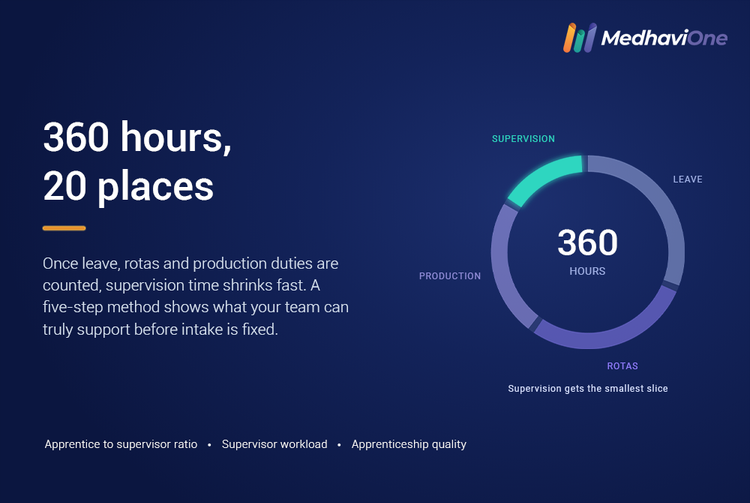
Take a department with eight qualified supervisors working 45 hours a week. Nominal supervision time is 360 hours. Assume 85% availability after leave, rotas and absence, which leaves 306 hours. Assume that only 40% of those hours can be given to apprentices, which leaves 122 hours. If the blended need is six guided hours per apprentice each week, capacity is 20 apprentices.
A planner who divided the nominal 360 hours by six would have promised 60 places. The figure below shows where the other 40 disappear.
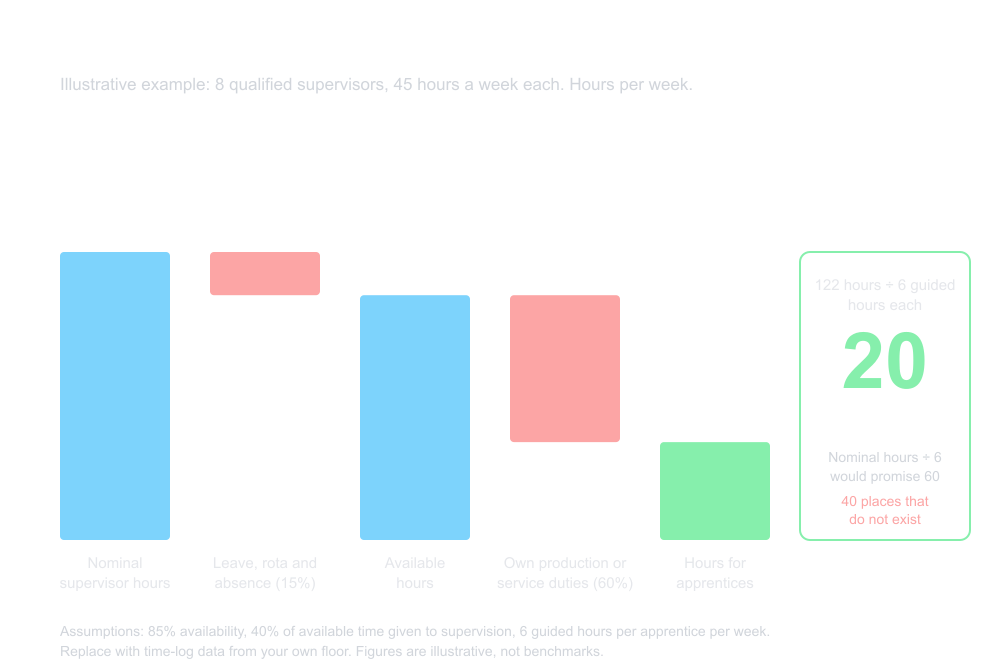
The percentages and hours above are assumptions for illustration, not benchmarks. Replace them with time-log data from your own floor.
Apply the Ratio Ceiling for Each Experience Level
Hours are one limit. Supervisor-to-apprentice ratios are another, and regulators elsewhere tie them to experience. South Australia sets maximum ratios by level of supervision, from 1:3 for high-level supervision to 1:10 for low, and applies the strictest ratio when a supervisor oversees apprentices at different levels (Safe Work SA, n.d.; Government of South Australia, n.d.). Its electrical industry guidance asks for 1:1 for first- and second-year apprentices and a maximum of 1:3 for those in their third and fourth years (NECA SA, n.d.). New South Wales applies 1:1 under direct supervision of electrical apprentices and 1:3 under general supervision (NSW Government, n.d.).
These are not Indian requirements, and each trade should be checked against its own norms. The logic still travels: the newer the apprentice, the fewer a supervisor can hold. In our example, eight supervisors at a 1:3 ceiling would cap intake at 24, so the hours-based figure of 20 is the binding constraint. Always plan to the lowest of your ceilings.
Test Your Capacity Against the Intake Band
For a 200-person establishment, the 2.5% to 15% band works out to between 5 and 30 apprentices. A capacity of 20 sits comfortably inside it. Whether the band binds your organisation depends on your trades and notifications, so confirm it with the State Apprenticeship Adviser.
If capacity falls below the band, widen the supervisor pool rather than thin the supervision. Three levers help:
- Train more experienced employees as supervisors.
- Stagger intake through the year so first-year learners do not cluster.
- Move non-teaching tasks away from supervisors.
What to Measure After Intake
Capacity is a forecast, and forecasts need checking. Track three measures every quarter: actual guided hours per apprentice against plan, supervisor load by shift, and apprentice progression against the training plan. If guided hours run below the planned six, reduce the next cohort rather than hoping the gap closes.
Ask How Many You Can Teach Well
Supervision hours turn the intake question from "how many can we take?" into "how many can we teach well?" MedhaviOne works with employers on work-integrated pathways where that question is asked first.
References
Directorate General of Training (n.d.) FAQs: Apprenticeship under the Apprentices Act, 1961. Ministry of Skill Development and Entrepreneurship, Government of India.
Government of South Australia (n.d.) Starting safe: supervision and safety. MyTraining, Government of South Australia.
NECA SA (n.d.) Apprentice supervision guidelines. National Electrical and Communications Association, South Australia.
NSW Government (n.d.) Supervision practice standard for licensed electricians supervising apprentices. New South Wales Government.
Safe Work SA (n.d.) Apprentices and trainees. Government of South Australia.
Frequently asked questions
It is the number of apprentices a team can guide properly in a normal working week, calculated from the supervisor hours genuinely available for teaching rather than from headcount or nominal hours.
It depends on the trade, the risk and the apprentice's experience. Regulators in South Australia and New South Wales, for example, allow 1:1 for early-stage electrical apprentices and up to 1:3 as they progress.
The Act sets an intake band of 2.5% to 15% of the workforce for establishments with 30 or more workers. A capacity calculation tests whether you can meet that band without diluting supervision.
At every intake, and whenever the supervisor roster, shift pattern or apprentice mix changes materially.

Khyati Arora
Khyati Arora is a Content Strategist with 5+ years of experience in strategic content, B2B communication, and education storytelling. She specialises in higher education, workforce transformation, and learner engagement, creating insight-led content that connects academia, industry, and career pathways.