Table of contents7 sections
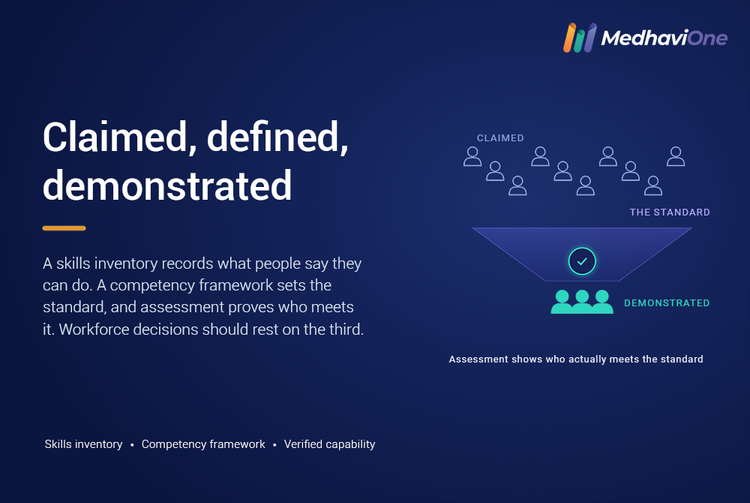
A skills inventory records what people say they can do. A competency framework defines what a role requires. Assessment shows what a person can demonstrably do against that requirement. Most organisations hold the first, are part-way through the second, and quietly treat all three as one exercise.
So here is the question worth asking of your own workforce data: how much of your skills inventory is self-reported, and how much has been demonstrated?
The answer matters more each year. Employers surveyed for the World Economic Forum expect 39% of workers' core skills to change by 2030, and 59 of every 100 workers globally will need training (WEF, 2025). Decisions about redeployment, succession and training spend all assume you know what capability you already have.
Why Self-Reported Skills Cannot Carry Workforce Decisions
Self-reporting is the weakest evidence in a skills inventory, and the research is consistent on this. Zell and Krizan (2014) synthesised 22 meta-analyses and found that the average correlation between people's self-evaluations of ability and their objectively measured performance was .29, with individual studies ranging from .09 to .63. Insight was stronger when skills were specific to a domain and the performance tasks were objective.
Dishonesty is not the issue. People simply lack a shared yardstick. Two employees who both tick "advanced" for data analysis may mean entirely different things, and an inventory without defined levels cannot tell them apart. That is the job of a competency framework.
None of this makes the inventory useless. It is cheap to collect, scales across thousands of employees and shows where to look first. The error is promoting it from a map of hypotheses to a basis for decisions.
Skills Inventory vs Competency Framework vs Assessment
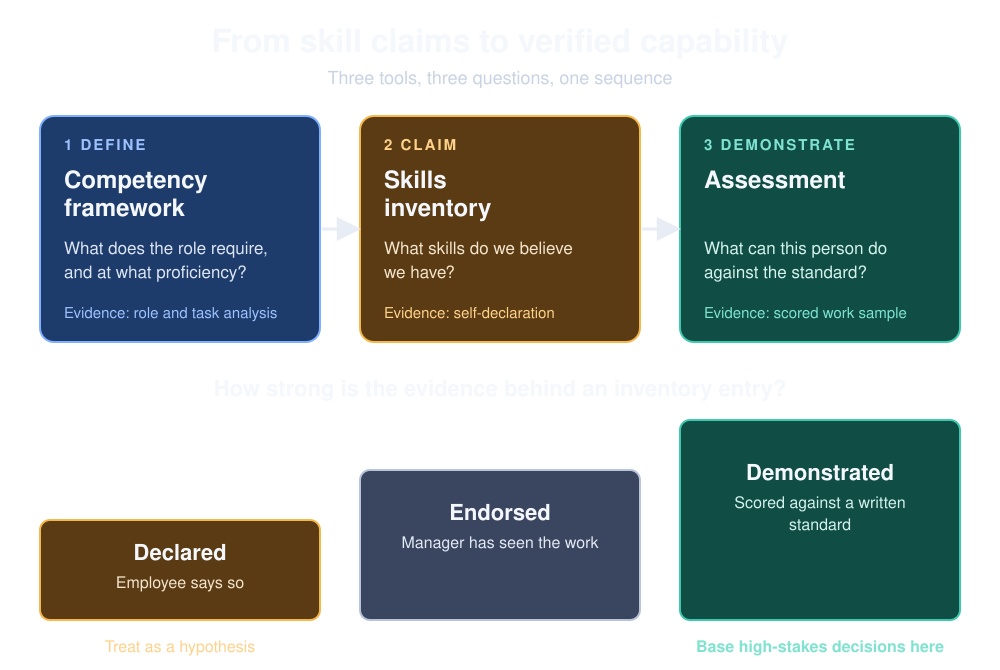
The three tools are often bought, built and reported as one thing. They answer different questions, and they need each other in a set order.
The sequence matters. The framework sets the yardstick, the inventory records claims against it, and assessment tests those claims. Without a framework, assessment has nothing to measure against. Without assessment, the inventory remains opinion, however neatly it is stored in an HR system.
Many organisations start with the inventory because it is the cheapest to collect. That is the reverse of the logic, and it is why entries are so often challenged later.
One Skill, Three Different Answers
Take "data analysis" in a finance team at a global capability centre. This example is illustrative, not drawn from a named client.
- Inventory: analysts declare data analysis as "advanced".
- Framework: for a senior analyst, "advanced" means three observable behaviours: building a reconciliation model from raw ledger data without supervision, documenting assumptions, and explaining a variance to a non-finance stakeholder.
- Assessment: a 90-minute work sample on an anonymised dataset, scored against those three behaviours by two reviewers.
Notice what the framework did. It converted a label into a testable statement. Once "advanced" describes behaviour, two managers can agree on it and an assessor can score it.
The useful finding sits in the gap between the first and third lines. Some who declared "advanced" will show a working level. Others who never listed the skill will meet the standard. Either result is a workforce decision you could not have made from the inventory alone.
How to Examine Your Own Skills Data
Put three questions to your own workforce data:
- What share of inventory entries has evidence beyond self-declaration, such as a manager's observation, a work sample or a scored assessment?
- Does every proficiency level have a written, observable definition that two managers would read the same way?
- When did you last test listed skills against actual work, and what happened to the entries that did not hold up?
If the honest answer to the first question is "very little", you are in good company. The point of asking is not to criticise the inventory but to know how far it can be trusted.
Begin with one critical role rather than the whole organisation. Define the standard, assess a small group against it, and compare the result with what the inventory said. The size of that gap is your baseline.
From Skill Claims to Verified Capability
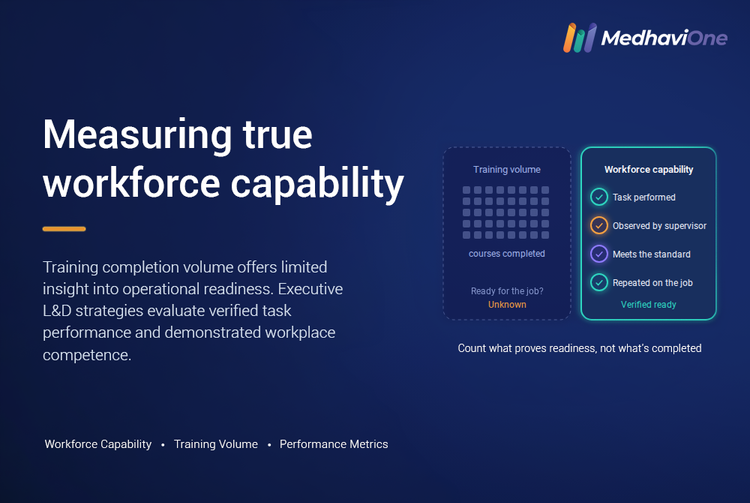
Moving to verified capability does not mean abandoning the inventory. It means labelling each entry by the strength of its evidence and letting high-stakes decisions rest only on the strongest. Three tiers are enough: declared by the employee, endorsed by a manager who has seen the work, and demonstrated against a written standard.
Role and capability mapping and Recognition of Prior Learning (RPL), which MedhaviOne Enterprise supports, follow the same logic: define the standard first, then recognise what has already been shown.
Every inventory begins as a list of claims. The work is to turn it, entry by entry, into a record of evidence.
References
World Economic Forum (2025) The Future of Jobs Report 2025. Geneva: World Economic Forum.
Zell, E. and Krizan, Z. (2014) 'Do people have insight into their abilities? A metasynthesis', Perspectives on Psychological Science, 9(2), pp. 111–125.
Frequently asked questions
An inventory records the skills people have declared. A competency framework defines what a role requires at each proficiency level.
It works as a starting hypothesis, not as evidence. Without assessment, entries remain unverified claims and should not drive promotion or redeployment decisions.
Reassess when a role's requirements change. With 39% of core skills expected to change by 2030 (WEF, 2025), critical roles need a regular cycle rather than a one-off exercise.
With one critical role: define the standard, assess a small group against it, and compare the result with the inventory.