Table of contents8 sections
- Why Classroom-First Hospitality Education Leaves a Readiness Gap
- What Industry-as-Campus Actually Means
- What Earning While Learning Changes for Students and Hotels
- Why NEP 2020 Makes Work-Integrated Degrees a Mainstream Choice
- How Hotels Should Measure the Return
- Where Hospitality Will Be Learned Next
- References
- Frequently asked questions
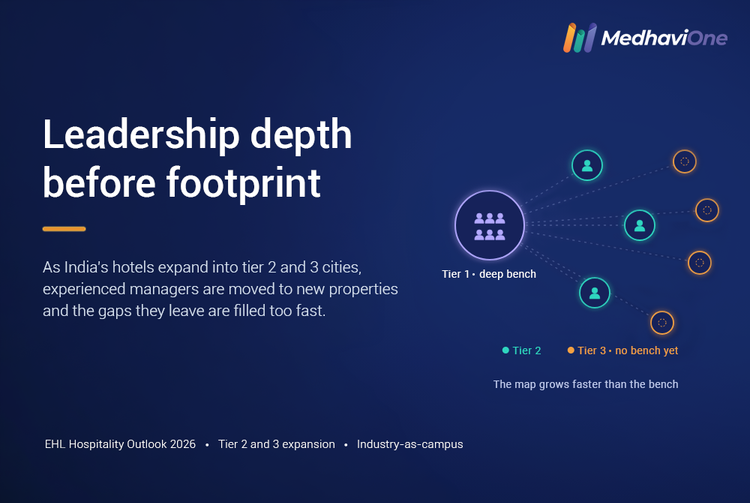
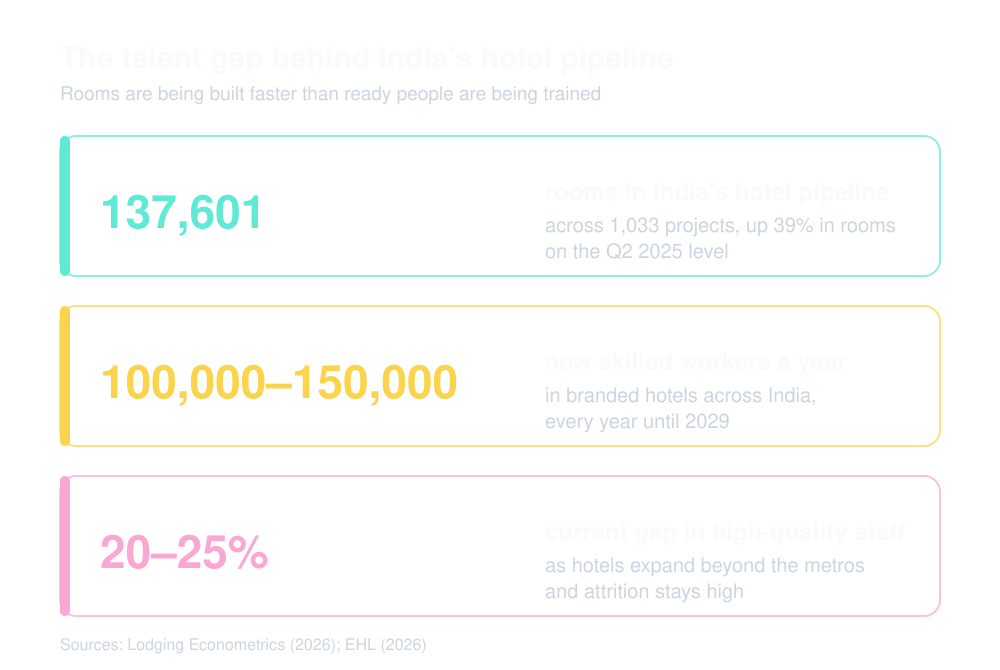
India's hotel industry has no shortage of ambition. Lodging Econometrics counts a national pipeline of 137,601 rooms across 1,033 projects, up 39% in rooms on its Q2 2025 level (Lodging Econometrics, 2026). What the industry does not have is enough trained people to staff them. EHL (2026) cites an estimate of 100,000–150,000 new skilled workers needed every year in branded hotels until 2029, and reports a 20–25% gap in high-quality staff today.
The usual response is to produce more graduates. India already does, and hotels still struggle to find them ready. A better question is where hospitality is actually learned. This article argues that the answer is increasingly inside the hotel itself, and that earn-while-you-learn education is the model best placed to close the gap.
Why Classroom-First Hospitality Education Leaves a Readiness Gap
The shortage is not new, and it is not a numbers problem alone. A Ministry of Tourism study put the manpower shortage at 2.6 million in 2018, and HVS (2022) projected a deficit of 1.1 million workers by 2025, even though hospitality colleges graduate students every year. The sector employed 8.8% of India's workforce in 2019 (HVS, 2022), so the stakes are far from marginal.
Why do trained graduates not become ready staff? HVS (2022) points to the distance between the glamour young people expect and the long hours and physical demands they meet, with IT, retail and e-commerce offering competing options. EHL (2026) adds high attrition and uneven middle-management skills.
As a linguist, I find the pattern familiar. Nobody becomes fluent from a grammar book alone; fluency arrives through use, correction and consequence. Service is a language too, made of tone, timing and anticipation. A student who first meets a full banquet shift in the final year discovers the grammar and the speakers at the same moment. That late discovery is costly for the learner and for the hotel that trained them.
What Industry-as-Campus Actually Means
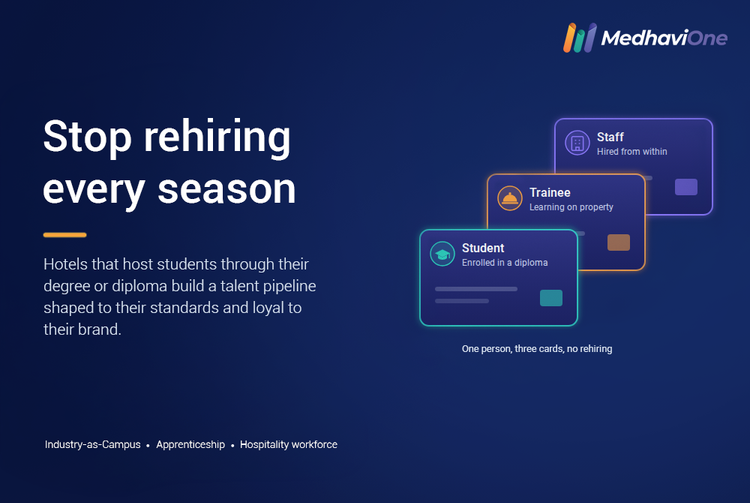
Industry-as-Campus moves the place of learning. Instead of visiting a hotel for a short internship, the learner is based in one, and the hotel becomes the campus. MedhaviOne Academies describes its first academy, the Academy of Hospitality, in these terms: learners train inside participating partner hotels, and eligible learners receive a monthly stipend during paid industry-based learning (MedhaviOne, 2026). Its three-year B.Sc. in Hospitality & Hotel Management leads to a UGC-recognised degree under the ABC and NEP 2020 framework, and a one-year Professional Diploma offers an accelerated route (MedhaviOne, 2026).
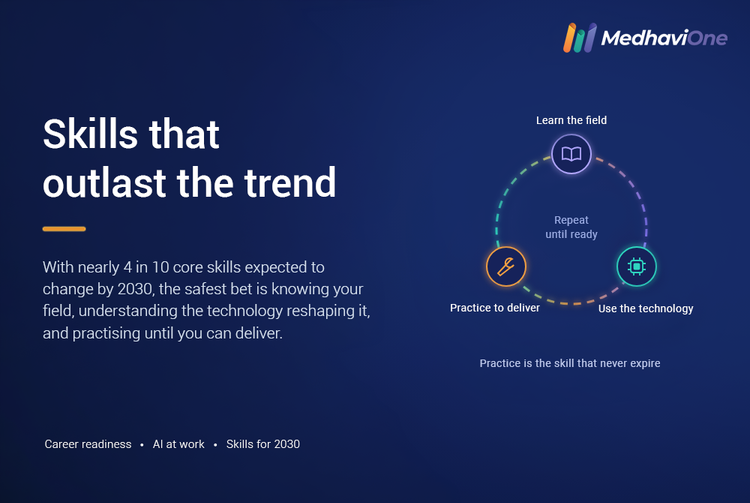
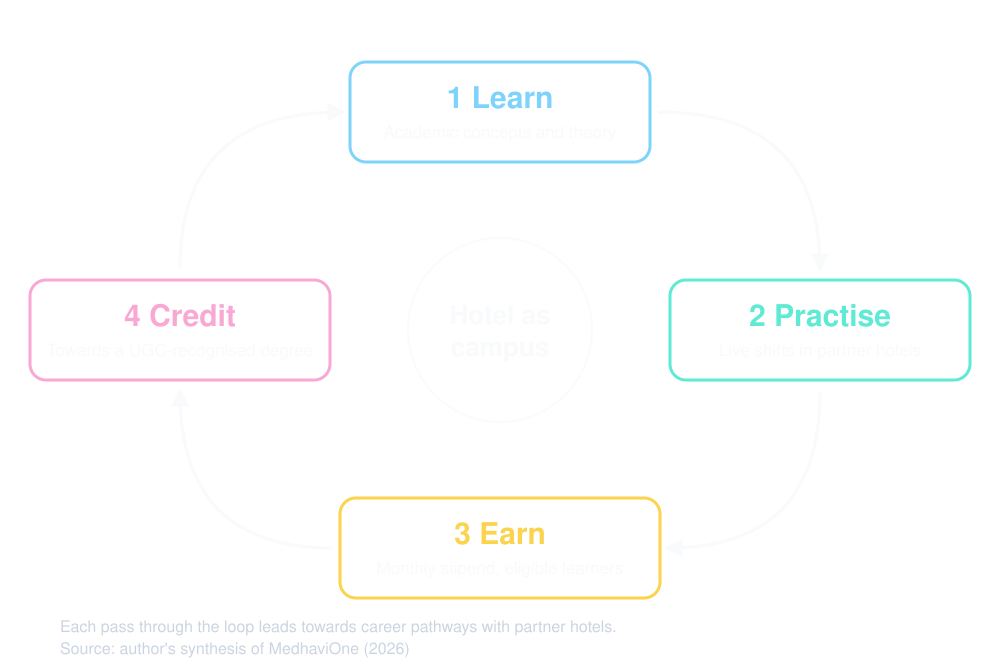
The design has four moving parts, and the loop matters more than any single one: learn the concept, practise it on a live shift, be paid for the contribution, and earn credit towards a recognised credential. Each pass through the loop shortens the distance between knowing and doing.
What Earning While Learning Changes for Students and Hotels
The stipend is not a perk. It changes who can afford to study hospitality and what the student expects of the work. When learning is paid, a family weighing a three-year degree sees a contribution towards cost rather than only an outflow, and the student experiences hotel work as employment from the first year, with its rosters and accountability, rather than as an unpaid placement.
For hotels the change is structural too. A cohort that rotates through departments is a pipeline that can be observed for years before any offer is made, so recruitment becomes selection among people already trained in the property's standards. HVS (2022) argues that clear growth paths and succession planning help the industry recruit and retain; a cohort model builds both in from the first day.
The table compares the two approaches on the dimensions that hotels and families tend to weigh.
Why NEP 2020 Makes Work-Integrated Degrees a Mainstream Choice
This is not a fringe experiment. UGC first issued guidelines on apprenticeship and internship embedded degrees in July 2020, in line with NEP 2020. Its 2024 edition names four aims: better employability, outcome-based learning, stronger links between institutions and industry, and a smaller industry skill gap (UGC, 2024).
The framework requires a tripartite agreement between the institution, the employer and the learner, setting out each party's responsibilities. Where the employer is a direct partner, the stipend is paid by the establishment under the Apprentices Act, 1961 (UGC, 2024).
For families, paid and structured work inside a degree is now a recognised design with obligations on every side. For institutions the expectation is sterner: a written agreement, not a handshake, must define what the learner does, learns and earns.
How Hotels Should Measure the Return
Earn-while-you-learn is easy to praise and easy to run badly. Three measures keep it honest:
- Twelve-month retention of cohort graduates, compared with conventionally hired staff in the same departments.
- Time to independent shift, the weeks between joining and running a section without supervision.
- Cohort conversion, the share of learners who accept a full-time role with the partner hotel.
Pay, rosters and supervisor quality still decide whether anyone stays; a stipend cannot repair a poor manager. EHL (2026) urges hotels to treat skill-building and retention as real priorities rather than "HR afterthoughts". Hotels that name a mentor for every learner, protect learning hours from rota pressure and review the cohort each quarter give the model its best chance.
Where Hospitality Will Be Learned Next
India will keep adding rooms; the harder task is adding people who can serve in them well. The useful debate is no longer whether students should work during their studies, but whether that work is designed as learning, paid fairly and assessed seriously. Models such as Industry-as-Campus, which MedhaviOne Academies applies in hospitality, answer that design question directly. Hotels that treat their floors as classrooms may find that their most dependable recruitment channel is one they already run.
References
EHL (2026) Hospitality Outlook 2026 – India: Scaling Beyond the Metros. EHL Insights Whitepaper. Lausanne: EHL.
HVS (2022) 'HVS Monday Musings: Indian hospitality sector – skill shortage to hinder recovery and growth', HVS, 27 February.
Lodging Econometrics (2026) India Construction Pipeline Report, as reported in 'Why India's hotel boom isn't slowing down any time soon', Hotels Magazine.
MedhaviOne (2026) MedhaviOne Academies. MedhaviOne website. Accessed 23 November 2026.
University Grants Commission (UGC) (2024) Guidelines for Higher Educational Institutions to Offer Apprenticeship Embedded Degree Programme (AEDP). New Delhi: UGC.
Frequently asked questions
It is a work-integrated model in which learners are based inside partner hotels, so the hotel functions as the campus. Academic study, paid industry experience, credits and a career pathway are designed as one programme (MedhaviOne, 2026).
No. The work sits alongside academic study. MedhaviOne's three-year B.Sc. in Hospitality & Hotel Management leads to a UGC-recognised degree under the ABC and NEP 2020 framework (MedhaviOne, 2026).
Under UGC's guidelines, the employer pays the stipend when it partners directly with the institution, under the Apprentices Act, 1961. Where the NATS portal is used, the government pays per the agreement (UGC, 2024). For MedhaviOne Academies, amounts and eligibility are set in each programme's details.
Growth in rooms is outpacing the pipeline of ready talent, attrition is high, and hospitality competes with sectors such as IT and retail for young workers (HVS, 2022; EHL, 2026).
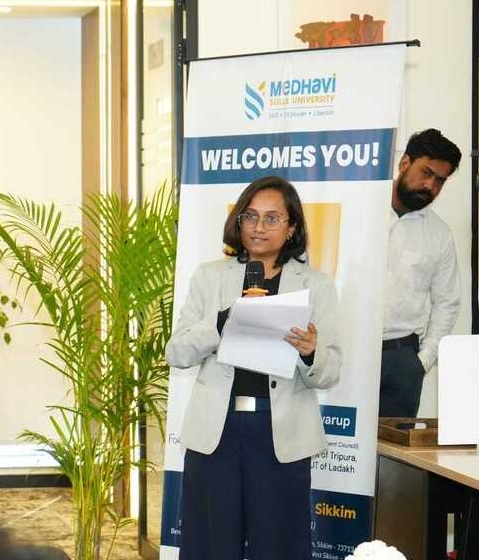
Dr. Adrita Dutta Roy
An academic, educator, and linguist, Dr. Adrita Dutta Roy brings over ten years of corporate expertise spanning news, publishing, global capability centres, and study-abroad sectors. She leverages her background in communication and entrepreneurship to seamlessly connect higher education with industry practice.