Table of contents7 sections
India's graduates are more employable than they were a few years ago, yet the degree itself still struggles to point towards a job. The India Skills Report 2026 puts graduate employability at 56.35 per cent, up from 54.81 per cent a year earlier (India Skills Report, 2026). NITI Aayog, however, points to Economic Survey data showing that only 8.25 per cent of graduates work in roles aligned with their qualifications (Business Today, 2026).
Both findings can hold at once. Learners are picking up skills, but the degree is rarely designed around the work those skills serve. The workforce-integrated university, a higher education institution (HEI) that builds employers into the degree itself, is the structural answer.
Why Degrees and Jobs Keep Drifting Apart
The drift is structural, and the numbers are large. NITI Aayog's report, Reimagining Skilling for Viksit Bharat, notes that 1.13 crore of India's 3.4 crore undergraduates are enrolled in the B.A. alone, and that B.A., B.Sc. and B.Com enrolments together exceed two crore. It describes these generic degrees as having weak links to jobs (Business Today, 2026).
The pay consequence is visible too. The report cites an average starting salary of Rs 22,000 a month for a generic undergraduate without additional skilling, against Rs 29,000 with it (Business Today, 2026).
Having worked across news, publishing and global capability centres, I have seen the pattern from the hiring side. Employers rarely doubt a graduate's intelligence. They doubt how quickly that graduate can do the job, because the curriculum was settled years ago and industry met the student only at the placement drive.
What Makes a University Workforce-Integrated
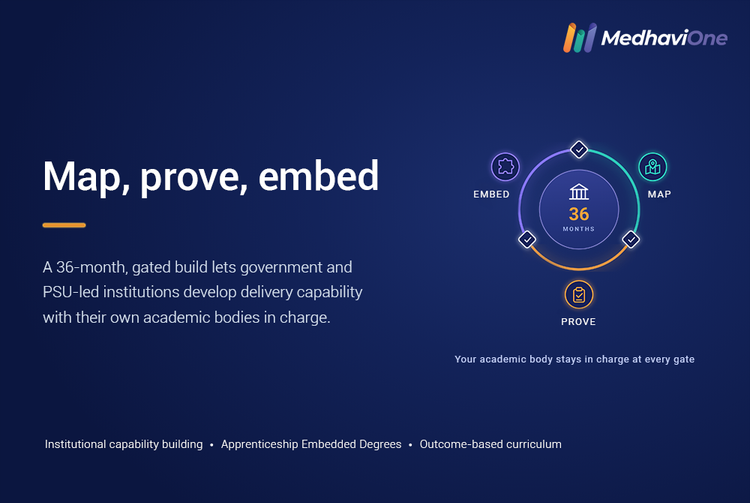
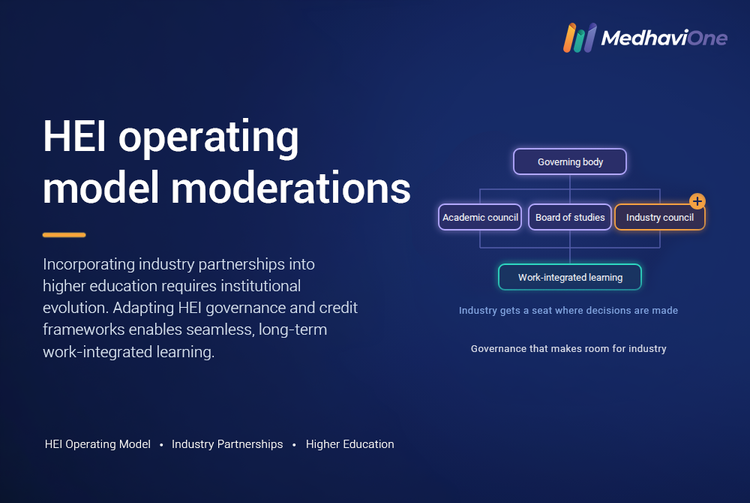
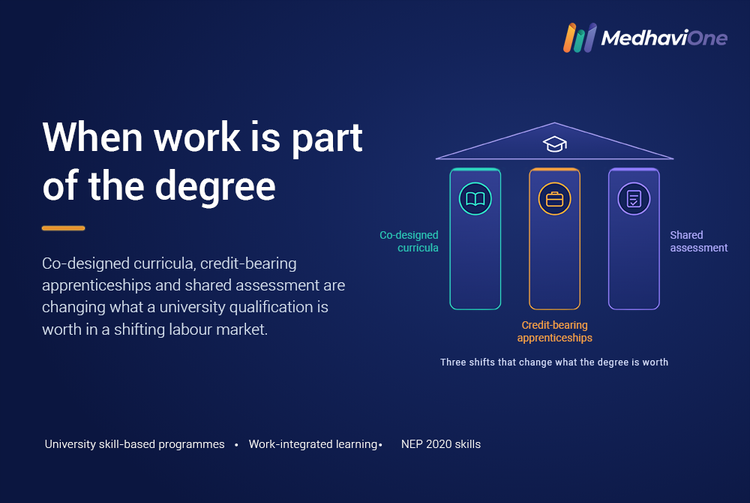
A workforce-integrated university designs the degree with employers from day one, so that work is part of the learning rather than an epilogue to it. India's regulator has already described the architecture. The UGC's Apprenticeship Embedded Degree Programme (AEDP) guidelines set out four building blocks (UGC, 2025).
- Co-designed curriculum. The HEI designs the programme in consultation with industry, and statutory authorities approve it before launch.
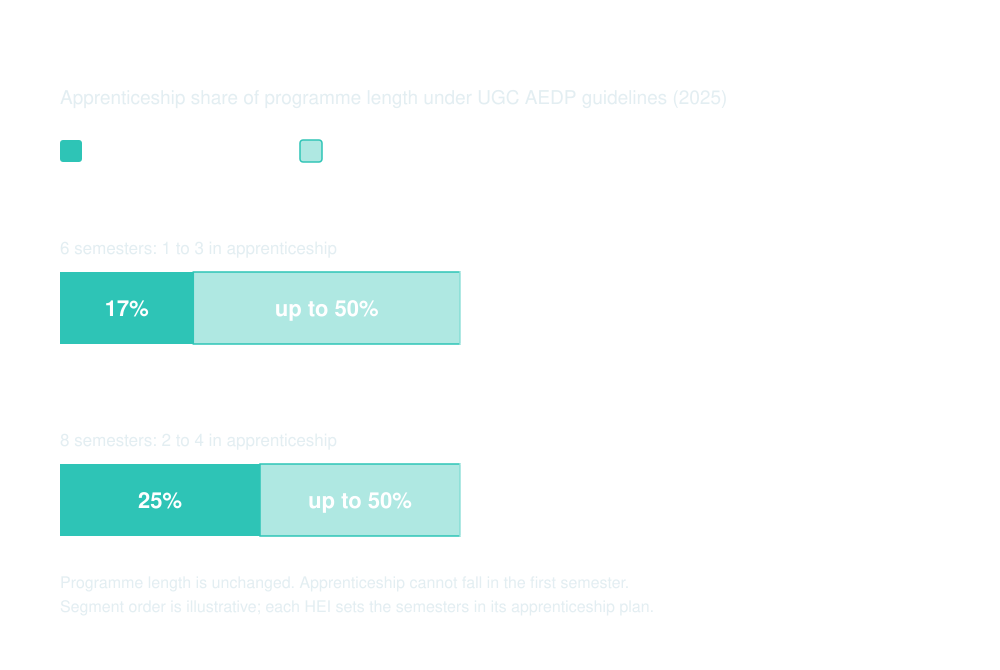
- Structured workplace time. A three-year undergraduate programme includes at least one and at most three semesters of apprenticeship. A four-year programme includes between two and four. The apprenticeship cannot fall in the first semester.
- Shared assessment. Industry evaluation carries 30 to 40 per cent, faculty-mentor evaluation from site visits another 30 to 40 per cent, and a seminar and viva at the HEI the remainder.
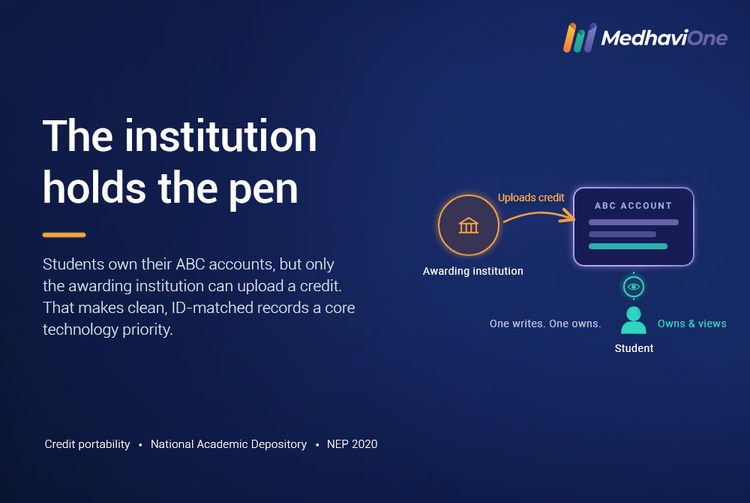
- Credit for what is learned. Credits follow duration, with a three-month apprenticeship earning 10 credits, and are uploaded to the Academic Bank of Credits.
Traditional HEI vs Workforce-Integrated HEI
The difference is less about adding an internship than about who shares responsibility for the learner.
The measure-of-success row follows NITI Aayog's recommendation to judge programmes by outcomes rather than by enrolment (Business Today, 2026).
What Good University Skill-Based Programmes Look Like
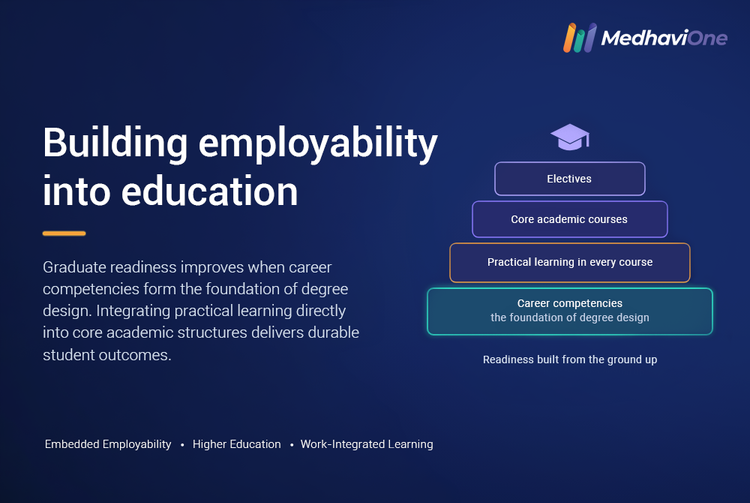
University skill-based programmes fail when skills are bolted on as a short add-on course. They work when the degree is rebuilt around an applied specialisation. NITI Aayog's examples are a B.A. in Hospitality and a B.Com in Analytics, where the discipline and the occupation share one curriculum (Business Today, 2026).
The research on work-integrated learning (WIL) adds a useful caution. Jackson and Dean (2023) analysed Australian Graduate Outcomes Survey data from 76,261 respondents. They found that different forms of WIL build different capabilities. Work-based WIL, such as placements, was linked to feeling prepared for employment. Non-workplace WIL showed larger perceived gains in collaborative skills, and global WIL built adaptive skills. Their conclusion is that several forms of WIL, scaffolded across the programme, serve graduates better than one placement at the end.
For university skill development, this means mixing the modes: live projects in year one, simulated or industry-set problems in year two, and a sustained apprenticeship later. Skills should be mapped to the roles employers actually fill, and assessed where the work happens.
Three Steps for HEI Leaders
The AEDP framework places real operational work on the institution. HEIs obtain statutory approvals, sign agreements with industry, prepare the apprenticeship plan, deliver classroom components, conduct assessment and upload credits (UGC, 2025). Leaders can sequence this in three steps.
- Confirm eligibility and approvals. An HEI must hold a NIRF university-category ranking or a valid NAAC grade, among other conditions (UGC, 2025).
- Choose two or three programmes and co-design them. Start where an employer can describe the role precisely, then write the curriculum, apprenticeship plan and assessment weights together.
- Measure outcomes, not enrolment. Track placements, income and career progression for each cohort, as NITI Aayog recommends (Business Today, 2026).
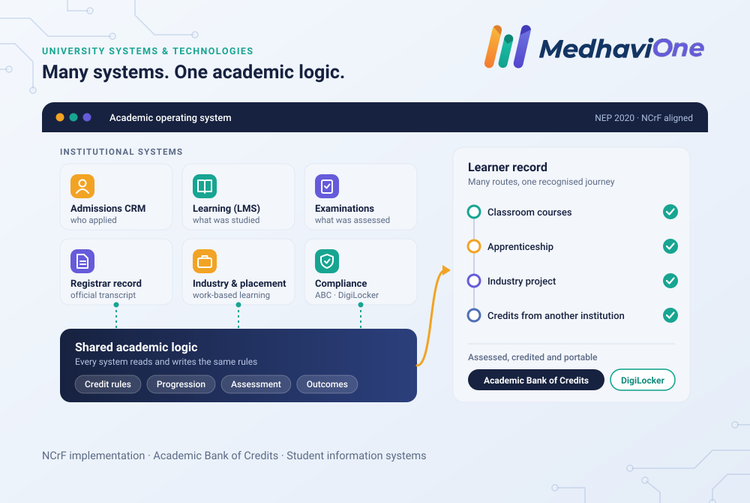
The operating burden, from agreements and stipend compliance to assessment records and credit uploads, is why this model needs academic systems and technology built for it. MedhaviOne University Systems & Technologies (MUST) supports HEIs with exactly that layer. The institutions that act early will define what a degree is worth in a changing labour market.
References
Business Today (2026) 'Only 8.25% graduates in jobs matching their degrees, NITI Aayog report flags skills gap', Business Today, 27 August. Reports NITI Aayog (2026) Reimagining Skilling for Viksit Bharat.
India Skills Report (2026) India Skills Report 2026. ETS, with CII, AICTE, AIU and Taggd.
Jackson, D. and Dean, B.A. (2023) 'The contribution of different types of work-integrated learning to graduate employability', Higher Education Research & Development, 42(1), pp. 93–110.
University Grants Commission (UGC) (2025) Guidelines for Higher Educational Institutions to Offer Apprenticeship Embedded Degree Programme (AEDP). New Delhi: UGC.
Frequently asked questions
It is an HEI that designs its degrees with employers and builds credit-bearing workplace learning into the programme, rather than treating internships and placements as extras.
Under UGC guidelines, it lets an undergraduate student complete apprenticeship training as an integral part of the degree, within the unchanged length of the programme.
A three-year undergraduate programme can include one to three semesters, and a four-year programme two to four, with none in the first semester.
They redesign the degree around an applied specialisation, with industry co-designing and assessing it, instead of adding a certificate beside a generic curriculum.
Institutions with a NIRF university-category ranking or a valid NAAC grade, subject to the conditions the UGC sets and the necessary statutory approvals.
Dr. Adrita Dutta Roy
An academic, educator, and linguist, Dr. Adrita Dutta Roy brings over ten years of corporate expertise spanning news, publishing, global capability centres, and study-abroad sectors. She leverages her background in communication and entrepreneurship to seamlessly connect higher education with industry practice.