Table of contents9 sections
- SEO briefIndia's higher education system is not simply getting larger. It is becoming structurally more complex, and most institutional technology was not built for that complexity.
- Why Is the Programme No Longer the Only Unit of Academic Design?
- Digitisation vs Institutional Architecture: Where the Gap Lies
- The Four Layers Every Modern Academic System Must Represent
- Why Practice-Led Institutions Feel This Most
- Where MedhaviOne University Systems and Technologies (MUST) Fits
- Inescapable System Questions
- References:
- Frequently asked questions
SEO briefIndia's higher education system is not simply getting larger. It is becoming structurally more complex, and most institutional technology was not built for that complexity.
Enrolment reached 4.50 crore students in 2023–24, up from 3.42 crore in 2014–15 (MoE, 2025). Over the same period, the rules governing how students learn, earn credits and progress have been rewritten. More than 700 universities and 7,500 affiliated colleges have adopted the National Credit Framework, and 3,123 institutions had been onboarded to the Academic Bank of Credits by August 2026 (MoE, 2026).
Having spent much of my career between newsrooms, publishing houses, global capability centres and the study-abroad sector, I have watched several industries go through this moment. The pattern is consistent. Organisations digitise their functions first, and only later discover that the functions do not describe the same reality. Higher education has now reached that second stage.
The question is no longer whether universities use technology. It is whether technology can carry the academic logic of the institution itself.
Why Is the Programme No Longer the Only Unit of Academic Design?
Under the National Credit Framework, creditable learning includes academic education, vocational education and training, and relevant experiential learning. Credits can be accumulated, stored, transferred and redeemed, subject to assessment (UGC, 2023).
For decades, institutional systems assumed a fixed sequence: admit a student to a programme, run semesters, conduct examinations, record results and award a qualification. That sequence still exists, but it no longer describes every learner.
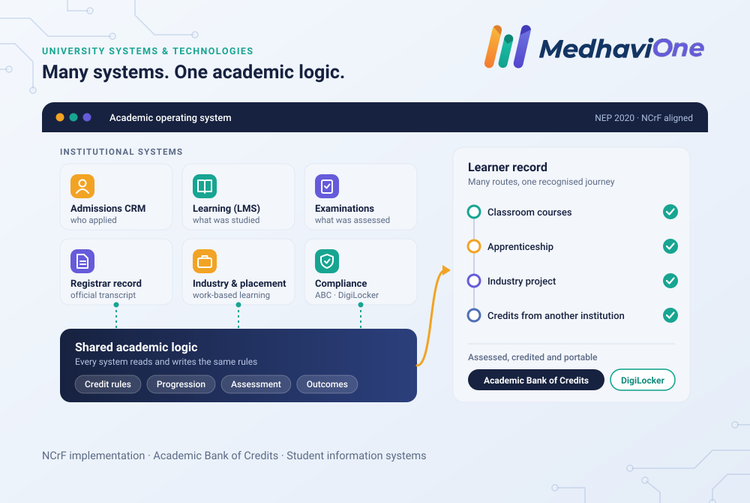
A single learner today may complete classroom courses, undertake an apprenticeship, earn approved credits through another mode of learning and contribute to a live industry project, all while building towards one recognised qualification. A university system therefore needs to know more than the fact that Course A and Course B were completed. It must understand what each experience represents, how it was assessed, which credits it carries, which rules govern its recognition and how it counts towards progression.
That is a fundamentally different requirement from maintaining a digital student record. The flow below shows why.

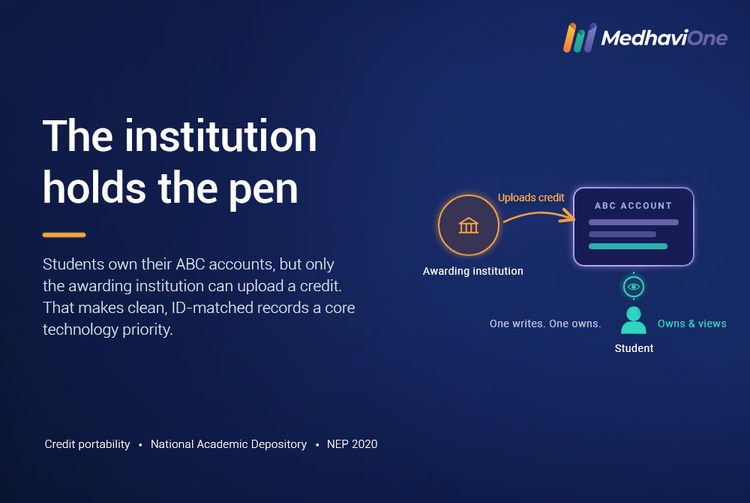
Whichever route the learner takes, the institution's system has to apply the same assessment and credit logic before anything reaches the Academic Bank of Credits.
Digitisation vs Institutional Architecture: Where the Gap Lies
Most serious institutions already run a CRM for admissions, a Student Information System, an LMS, an examination platform, finance software, placement tools and separate systems for credentials or regulatory reporting. The existence of these systems is not the problem. The harder question is whether they describe the same academic journey.
Each system can be perfectly functional while the institution still lacks a complete view of how learning, experience, credits and outcomes relate to one another.
Digitisation records activity. Institutional architecture determines what that activity means.
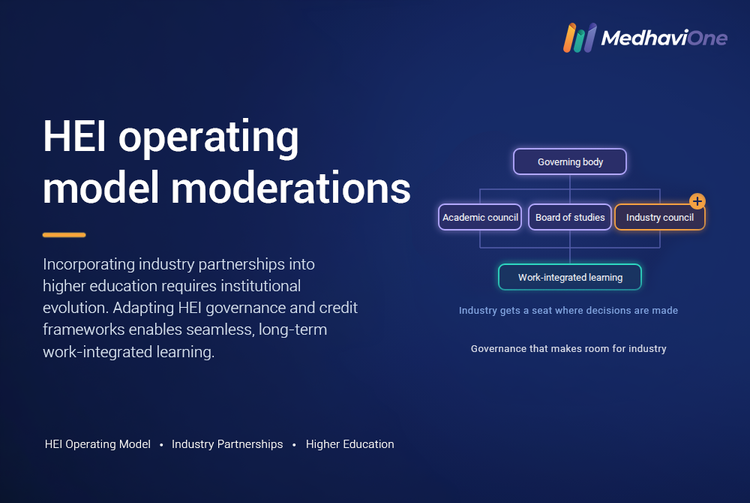
For a Dean designing a new programme, the distinction is practical, not theoretical. If a six-month industry immersion is part of the curriculum, its place in the learner journey cannot depend on a spreadsheet maintained by another department. If an external learning experience carries recognised credits, the rules governing those credits belong inside the academic system itself.
The Four Layers Every Modern Academic System Must Represent
In my work at the intersection of higher education and industry, I find it useful to think of a credible academic system as four connected layers rather than a stack of separate tools.
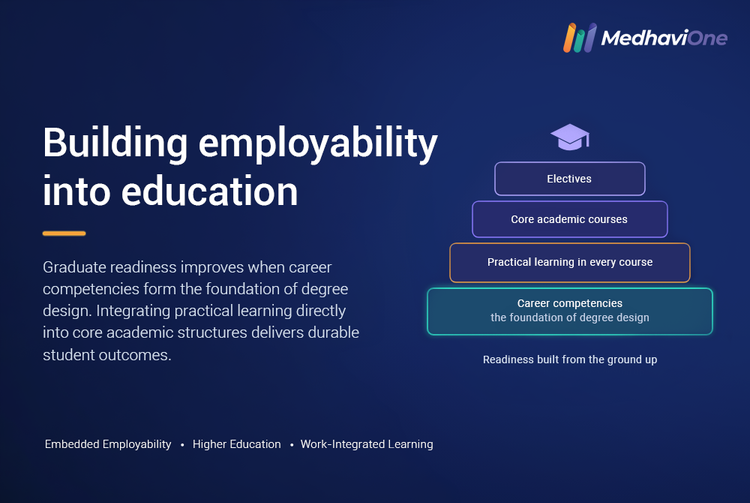
1. Academic architecture. Programme structures, credits, prerequisites, electives, assessments, equivalencies and progression rules should exist as structured logic inside the system, not as administrative documents sitting beside it.
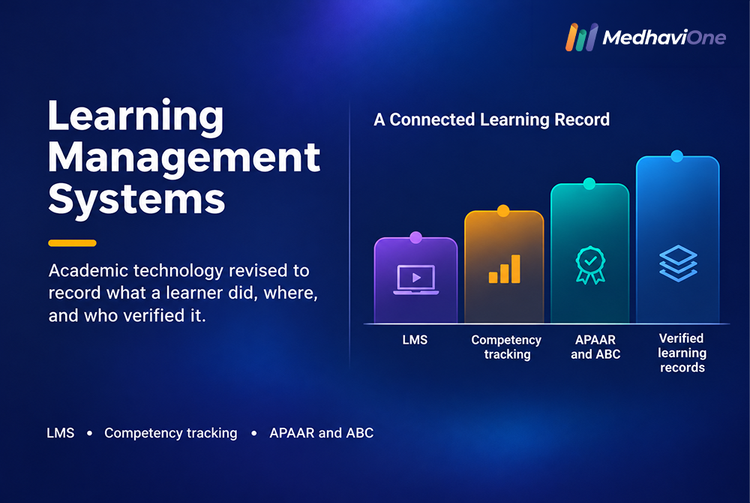
2. The learner record. As pathways become more flexible, the institution needs a reliable account of what a learner has completed, what has been recognised and what remains for progression. Integration with the Academic Bank of Credits and DigiLocker becomes part of this record, not an afterthought.
3. Learning beyond the classroom. Internships, apprenticeships, clinical exposure, laboratories and live projects cannot stay peripheral. The institution needs to know where each sits in the programme, how it is evaluated and whether its intended outcomes were met.
4. Institutional evidence. A placement percentage tells one story, a transcript another and an internship report a third. The real analytical value appears when leaders can read progression, practical exposure, credit achievement and employment outcomes together.
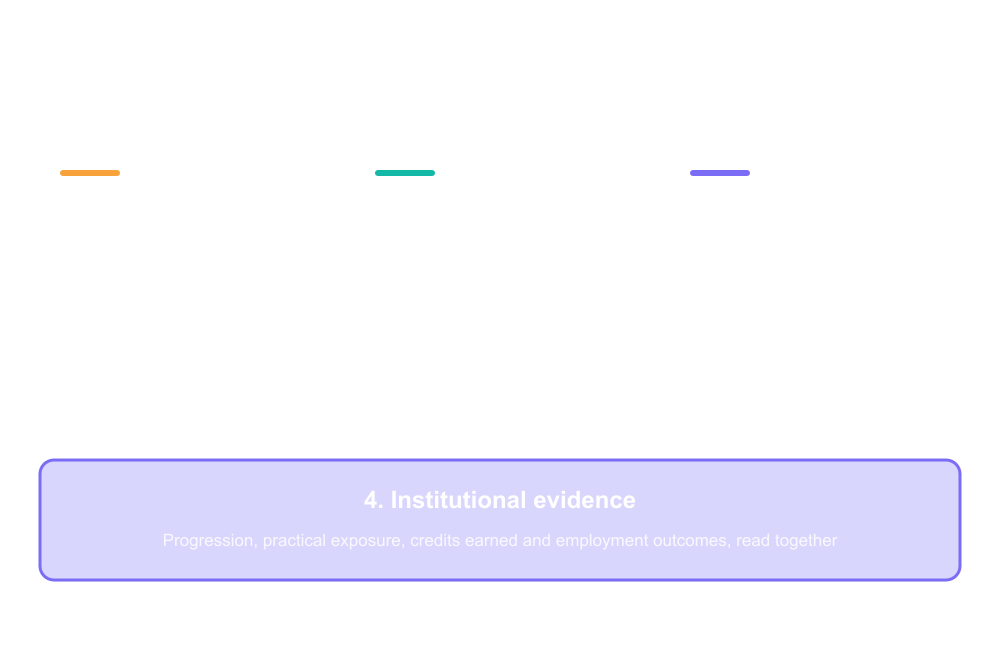
The first three layers are where most institutions invest. The fourth, the one leadership actually reads, only becomes reliable when the three beneath it share the same academic logic.
Why Practice-Led Institutions Feel This Most
The challenge is sharpest for specialised education and training organisations. Many have spent years building learning models around real professional practice: live coding, clinical exposure, financial-market simulations or shopfloor environments. That applied model is their advantage.
The mistake would be to force such models into a conventional academic template. The stronger opportunity is an academic and technology architecture that preserves the applied model while giving learners structured progression, recognised credit and clearer pathways into employment.
This thinking is already visible across models within the MedhaviOne ecosystem. IMS Proschool connects practical finance education with recognised credentials. Emversity combines healthcare education with clinical and work-integrated learning. Polaris School of Technology connects an intensive coding model with a recognised higher education pathway. Each has a different applied core, yet each needs an architecture that maps that core to assessment, credit and progression.
Across these models, the common problem is not content delivery. It is translating a specialised learning model into an academic system an institution can govern, audit and stand behind.
Where MedhaviOne University Systems and Technologies (MUST) Fits
This is the context in which MedhaviOne University Systems and Technologies (MUST) has been designed. It works across four institutional areas that mirror the layers above: Academics & Governance, Technology & ERP, Work-Integrated Learning, and Regulatory & Compliance.
The academic layer includes NEP and NCrF-aligned degree architecture, academic processes and assessment administration. The technology layer covers a cloud-based SIS, LMS and learner lifecycle infrastructure. Work-integrated learning connects programmes with apprenticeships, internships, industry participation and hiring networks. The regulatory layer spans institutional workflows as well as DigiLocker and ABC credit integration.
What matters is not any single component. It is whether academic design, technology, industry learning and recognised credentials operate as parts of one institutional model. That is a more useful standard against which to judge any higher education technology, including ours.
Inescapable System Questions
Before the next procurement cycle, it is worth testing current infrastructure against a few plain questions.
- Can our system express a programme's credit and progression rules, or do they live in PDFs and spreadsheets?
- If a learner brings credits from another institution or a workplace, where is that decision recorded and by whom?
- Does an internship or apprenticeship appear in the academic record with its assessment, or only in the placement cell's files?
- Can we report programme outcomes that combine credits earned, practical hours and employment, without manual reconciliation?
- Would a new flexible pathway require a new system, or only a new set of rules within the existing one?
As programmes become more flexible and learning moves beyond the classroom, institutions will need systems that understand more than enrolment, attendance and examinations. They will need technology that represents how the institution believes learning should work. That is the point at which technology stops being software the institution uses and becomes part of its operating system.
References:
Ministry of Education (2025) All India Survey on Higher Education 2023–24. New Delhi: Department of Higher Education, Government of India.
Ministry of Education (2026) National Credit Framework adoption and Academic Bank of Credits onboarding data. New Delhi: Government of India.
University Grants Commission (2023) National Credit Framework (NCrF). New Delhi: University Grants Commission.
Frequently asked questions
The NCrF is a unified framework that assigns credits to academic education, vocational education and training, and experiential learning. It allows credits to be accumulated, stored, transferred and redeemed towards qualifications, subject to assessment.
The ABC stores a learner's earned credits digitally. Universities must therefore keep credit rules, assessments and recognition decisions in structured form so that records can be shared, verified and redeemed across institutions.
An ERP digitises individual functions such as admissions, fees and examinations. An academic operating system connects them through shared academic logic: programme rules, credits, workplace learning and outcomes in one model.
Workplace learning should be defined within the programme structure, with clear outcomes, assessment methods and credit values. It then sits in the official academic record rather than in a separate placement file.
MUST supports institutions across Academics & Governance, Technology & ERP, Work-Integrated Learning, and Regulatory & Compliance, including NCrF-aligned degree architecture and ABC and DigiLocker integration.