Table of contents7 sections
- Macro Drivers of Higher Education Reform in India
- Structural Limitations of the Placement-Centric Model
- Upstream Integration: Curriculum Architecture and Operations
- Industry Participation in Teaching, Assessment and Graduate Outcomes
- Five Systems That Turn Partnerships Into Infrastructure
- What Institutional Leaders Should Do in the Next 12 Months
- Frequently asked questions
Macro Drivers of Higher Education Reform in India
India's universities are being asked to do something their operating model was not designed for. They must expand access at national scale while producing graduates whose readiness is judged by employers, not examiners.
In short: industry partnership becomes institutional infrastructure when industry input is built into programme design, academic delivery, assessment and outcome tracking through repeatable systems, rather than managed as a placement-stage activity.
The scale alone makes the case. The All India Survey on Higher Education puts the Gross Enrolment Ratio at 28.4% in 2021–22, while NEP 2020 targets 50% by 2035. No institution can build that much industry-relevant capacity alone.
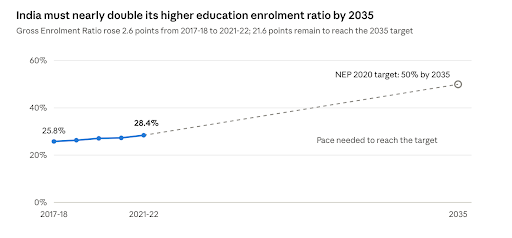
Regulation is moving the same way. NEP 2020 calls for vocational and academic integration and industry internships. UGC's Professor of Practice guidelines (2022) allow industry experts to fill up to 10% of sanctioned faculty posts. The National Credit Framework (2023) lets learning at work earn academic credit. Industry is being written into the rulebook of how a university runs.
Structural Limitations of the Placement-Centric Model
Placement teams meet industry at the end of the learner journey. By then, curriculum choices made three years earlier have already fixed what graduates can do. A partnership managed there can sell the output; it cannot shape it.
This creates three structural costs. Lag: curricula revised on multi-year cycles trail roles that change every year. Leakage: relationships live with individuals, so a partner often leaves when an officer does. Lopsided value: employers are asked only for jobs and are offered nothing earlier in the cycle, so engagement stays transactional.
Upstream Integration: Curriculum Architecture and Operations
Integration is decided in the Board of Studies and the registrar's office long before it reaches a classroom. Institutions that treat industry as infrastructure redesign both.
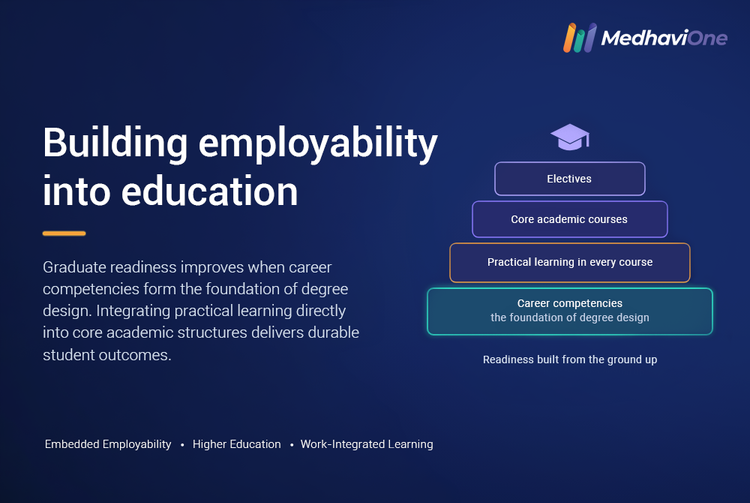
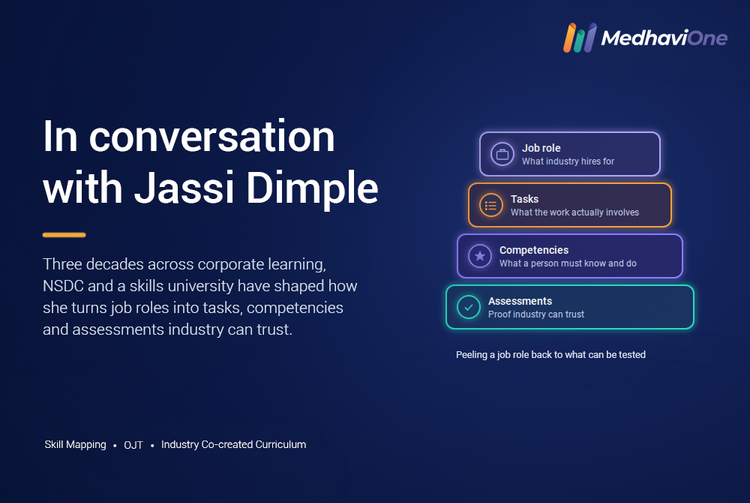
Programme design runs backwards from roles. Instead of starting with subjects, design teams start with the job roles a programme serves. They break each role into tasks, map tasks to learning outcomes, and only then allocate credits. Industry advisory boards hold a formal review step, not a courtesy seat.
Academic operations make that design workable. Four changes matter most:
- Timetables built around work-integrated blocks, so internships and apprenticeships sit inside the semester rather than around it.
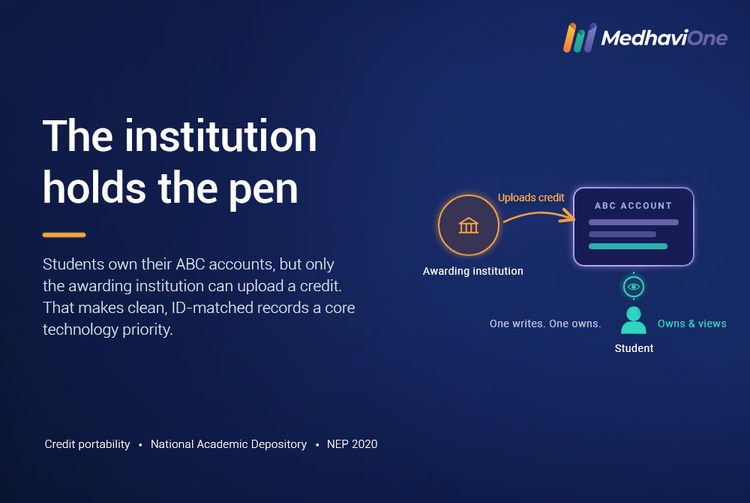
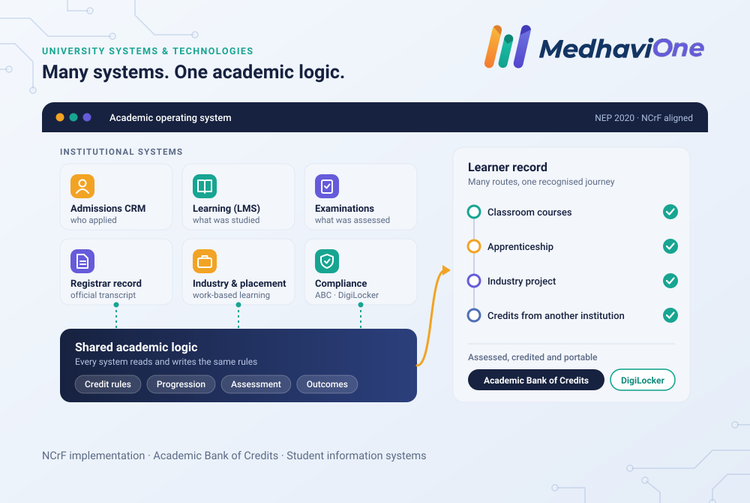
- Credit plumbing through the Academic Bank of Credits and the National Credit Framework, so learning at a partner's site counts towards the award.
- Faculty workload models that recognise industry mentoring, co-teaching and project supervision.
- A registrar's function equipped for partner agreements, apprenticeship contracts and compliance records.
Without the second set of changes, the first stays on paper. A brilliant curriculum still fails if the examination calendar cannot accommodate a twelve-week industry placement.
Industry Participation in Teaching, Assessment and Graduate Outcomes
Once design and operations are in place, industry can take part in teaching and evaluation itself, not only in hiring.
In delivery, Professors of Practice bring current practice into classrooms. Co-taught modules let a practitioner own a unit of a course, and apprenticeship-embedded semesters let learners do real work for credit.
In outcomes, industry assessors evaluate capstones against workplace standards, and employers report how graduates perform after hiring. That data now counts externally too: graduation outcomes are a scored parameter in NIRF rankings.
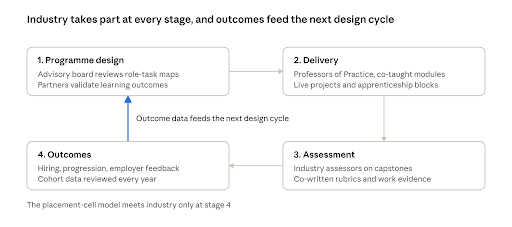
The loop is the point. When outcome data returns to the Board of Studies every year, the curriculum stays current by design rather than by occasional revision.
Five Systems That Turn Partnerships Into Infrastructure
One strong partnership is a success story. Fifty partnerships that renew every year is infrastructure, and that takes systems rather than goodwill. Five are essential:
- A partner registry: every employer, contact, agreement and engagement in one CRM, owned by the institution.
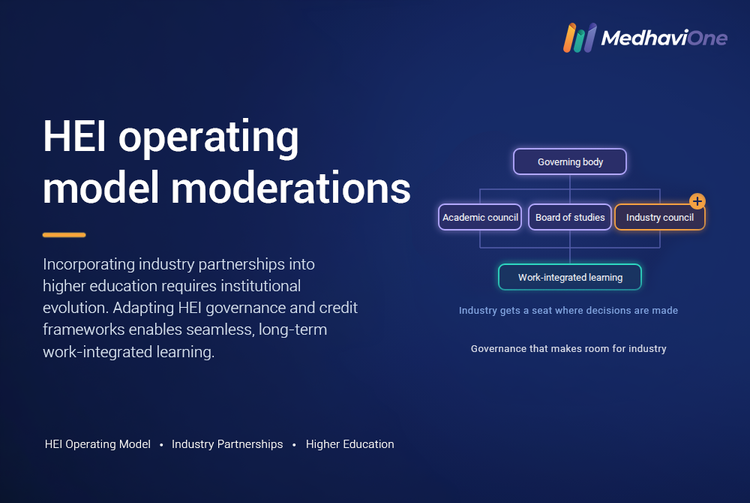
- A governance charter: an industry council with defined academic authority, meeting on a fixed calendar.
- Standard agreements: templates for MoUs, apprenticeships, intellectual property and data sharing, so each deal does not start from zero.
- Credit and assessment plumbing: rubrics, assessor onboarding and credit mapping that work across partners.
- An outcomes loop: cohort-level placement, progression and employer feedback data that flows back into programme review.
Most institutions sit somewhere on the maturity curve below. The goal is not to skip stages but to know which one you are in.
What Institutional Leaders Should Do in the Next 12 Months
The shift is a leadership decision before it is an academic one. Each role at the top has a different first move.
- Promoters and Vice-Chancellors: put industry integration in the institutional development plan, with a budget line and a named owner at Pro-VC level.
- Registrars: build the agreement templates, partner registry and credit-mapping process before scaling partnerships.
- Deans: choose two programmes and rebuild them backwards from job roles, with industry assessors in the capstone.
This is the territory MedhaviOne's MUST offering is built for. MUST works as an integration layer for universities and their education partners. It brings programme design, industry partnerships, academic operations support and outcome systems together, so industry integration runs as part of the institution rather than beside it.
The institutions that lead the next decade will not be the ones with the most MoUs. They will be the ones whose operating model cannot run without industry in it.
Frequently asked questions
It means industry input is built into how a university designs programmes, delivers teaching, assesses learners and tracks outcomes, supported by systems that survive staff changes. It is no longer a one-time placement activity.
The placement cell engages industry at the end of the programme, when curriculum and skills are already fixed. Partnerships that shape graduate readiness must begin at programme design.
NEP 2020 calls for integrating vocational and academic education and for industry internships. UGC's Professor of Practice guidelines and the National Credit Framework give institutions the mechanisms to act on it.
Five core systems: a partner registry, a governance charter, standard agreements, credit and assessment plumbing, and an outcomes data loop that feeds programme review.
Track the share of credits delivered with industry participation, the share of learners with a work-integrated component, partner renewal rates and cohort-level employment outcomes.