Table of contents8 sections
In decades before today, choices about work followed a path with ease. A person chose a subject, completed a degree, secured a position, and accumulated experience in a field. Today, planning brings uncertainty. Technology shifts in workplaces. Machines automate tasks. Roles appear in the economy, while positions transform at a pace that exceeds expectations.
For students, graduates, and professionals at the start of employment, context creates a question. People no longer ask only: "What should someone study to gain employment?" People ask instead: "What capabilities retain value as tasks change?"
An answer does not require chasing trends in technology or enrolling in courses that promise stability in careers. A skill does not carry a guarantee that value remains for eternity. Instead, a person can combine knowledge of a domain, capability in technology, and capabilities of humans. A combination of elements creates a foundation that assists growth over time.
Depth in a Field of Knowledge
Before someone selects tools for intelligence of machines or registers for training in analysis of data, understanding of a domain requires priority.
If a student chooses finance, the student needs understanding of finance. If an individual desires work in marketing, the person must learn how consumers, markets, and commerce function. If a person seeks work in hospitality, the individual must comprehend how operations run within enterprises in hospitality. Knowledge of a domain provides context in which applications of technology find utility.
Consider a professional in finance who uses the intelligence of machines to analyze statements. Value does not stem from knowledge of software alone. Value stems from understanding meaning within figures, formulating questions, and judging whether output accords with reality. This applies to a designer who uses software, a marketer who works with data, or a teacher who implements tools for instruction.
Technology changes with speed. Knowledge of a subject gives a base upon which an individual can build. Depth in a field provides context where tools find purpose. Development of depth in an area of choice forms the priority for a student. Capabilities in technology gain utility when an individual maintains understanding of areas for application.
Understanding Technology That Alters Work
After establishing a base in a domain, an individual must examine how technology transforms work.
A student does not need to become a developer of software simply because the intelligence of machines expands across sectors. However, an individual must understand what computing, automation, and analysis of data perform within a field of choice.
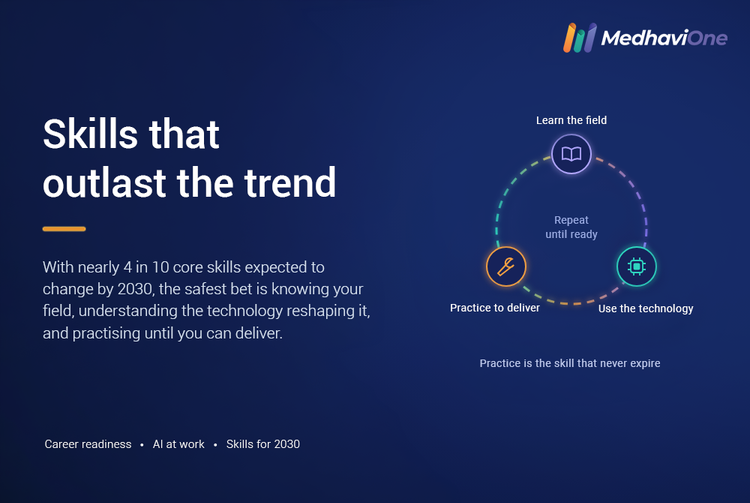
The Report on Jobs from the World Forum on Economy identifies intelligence of machines, data in volume, security of networks, and literacy in technology among areas of growth through 2030. Findings in the report estimate that thirty-nine percent of skill sets among workers will transform or face obsolescence between 2025 and 2030.
For a student, findings do not require learning tools without selection. Findings demand attention.
An individual should examine positions of interest. A student can read descriptions of jobs, note technologies that organizations specify, and observe capabilities that appear in listings. If the intelligence of machines enters a field, a student should learn how professionals apply tools in that domain.
Learning might involve courses on intelligence of machines, systems for analysis of data, tools for marketing across networks, software for design, or systems for sectors of choice. Selection depends on work that an individual intends to perform. Learning technology within context retains priority.
Capability of Humans in Workplaces
An assumption exists that advancement in technology reduces the necessity for capabilities of humans. Evidence from workplaces demonstrates the opposite.
Reports from the World Forum on Economy list thinking in analysis, resilience, flexibility, leadership, and influence in society among attributes that employers value.
Consider circumstances when individuals gain access to tools for intelligence of machines. Access to a tool loses distinction. Knowledge regarding application gains value.
Can a person pose a question with utility? Can an individual identify errors in output? Can a worker convey an idea with clarity? Can a member of a team collaborate with individuals who hold disagreement? Can a leader make a decision when information lacks completeness?
Capabilities of humans retain value across professions. Abilities gain strength when individuals combine elements with knowledge of technology.
Rather than choosing between skills in technology and capabilities of humans, workers should build both. Knowledge of a domain provides context. Technology enables execution. The capabilities of humans enable application. A combination of elements provides utility beyond seeking mastery over tools that appear and fade.
Focus on Capabilities Rather Than Tools
An error among students involves confusion between a tool and a capability.
A platform for software might enjoy usage today and experience replacement by systems years from now. An application for the intelligence of machines might achieve popularity and then vanish.
A capability beneath the surface retains utility over time.
Learning a platform for analysis of data offers utility. Learning how to analyze data offers transferability across systems. Learning how to operate an application for intelligence helps today. Understanding how to work with intelligence, check results, and solve problems creates a capability that moves with an individual.
Therefore, learning requires practice.
If a student completes a course in analysis of data, the student should apply the skill to data from operations. If an individual studies marketing on networks, the person should construct a campaign. If a student learns design, the student should assemble a portfolio. If an individual learns the intelligence of machines, the person should solve a problem in a field.
A certificate shows completion of a programme. A project demonstrates accomplishment.
Evaluation of Programmes on Networks
The volume of programmes for learning on networks creates difficulty during selection. Options exist for skills, and options promise outcomes with speed.
Do not select a programme simply because the programme enjoys popularity or offers a certificate.
Examine actions that a learner performs during a programme. Will the student execute projects? Will an instructor review work? Will a student solve problems that mirror situations in industry? Does content connect with practice in fields of work?
Courses with integration of industry provide advantages. Integration brings scenarios from workplaces into experiences of learning. Integration helps students comprehend how workers apply skills.
A principle applies to learning on networks. A programme should assist a student to move from comprehension to execution.
Before enrollment, an individual should ask a question: "What will a learner perform after completion that the learner cannot perform today?" If an answer lacks clarity, continue searching.
Creation of Plans for Learning
Pressure to acquire technology after technology causes exhaustion. Advertisements promote tools, certifications, and courses as requirements for survival in times ahead.
An individual does not need options without limit.
Begin with the position today and destination of choice. Examine positions that generate interest, and list skills that employers request. Compare requirements with knowledge in hand. The distance between requirements and knowledge creates a plan for learning with focus, rather than a list of courses from selections without strategy.
Then approach one skill at a time. Learn the skill. Practise execution. Build an artifact with the skill. After months, evaluate whether performance of tasks expanded beyond capability in months prior.
Measurement offers indication of progress, rather than count of certificates on a profile.
Adaptability Across Lifetimes
Graduation from a university will not mark the conclusion of learning.
An employee might enter a role and discover intent to transition into a domain of choice. An organization might introduce technology. Requirements for a role might shift. An industry might develop in directions outside expectation.
Because work transforms, learning across a lifetime becomes part of growth in careers.
In years following entry into work, programmes for advancement assist professionals to build capabilities while maintaining employment. Learning occurs through modules with duration of hours, projects in workplaces, mentorship, certification, or education in universities.
The goal does not involve remaining in a state of study. The goal involves building habits of learning when work demands capabilities.
Capabilities That Provide Flexibility
Predicting conditions of employment ten years from today poses difficulty.
An individual can prepare for adaptation.
Develop depth in a domain. Understand technology that alters work. Strengthen communication, thinking in analysis, and solution of problems. Select learning that offers opportunities for practice. Pay attention to requests from employers, and review capabilities as experience accumulates.
Recognise that the value of skills does not remain for eternity.
A skill can offer utility today and lose utility tomorrow. A skill can gain importance in times ahead. Responsibility does not demand prediction of changes.
Responsibility demands capacity for adaptation to change.
Capability for readiness does not rest in one tool or qualification. Capability rests in the ability to learn, discard habits that lose utility, and apply knowledge to tasks at hand.