Table of contents8 sections
Language experts separate two words that institution builders often use interchangeably. Capacity is what an institution has: campuses, sanctioned posts, a statutory mandate. Capability is what it can reliably do with them, term after term, without heroic effort from a few individuals.
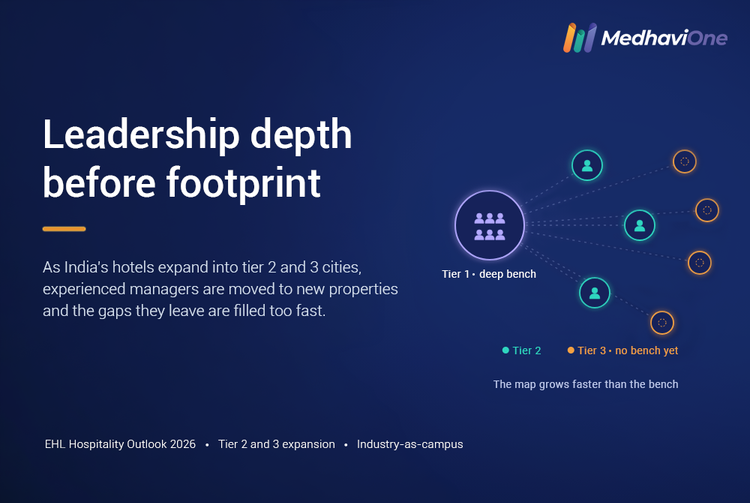
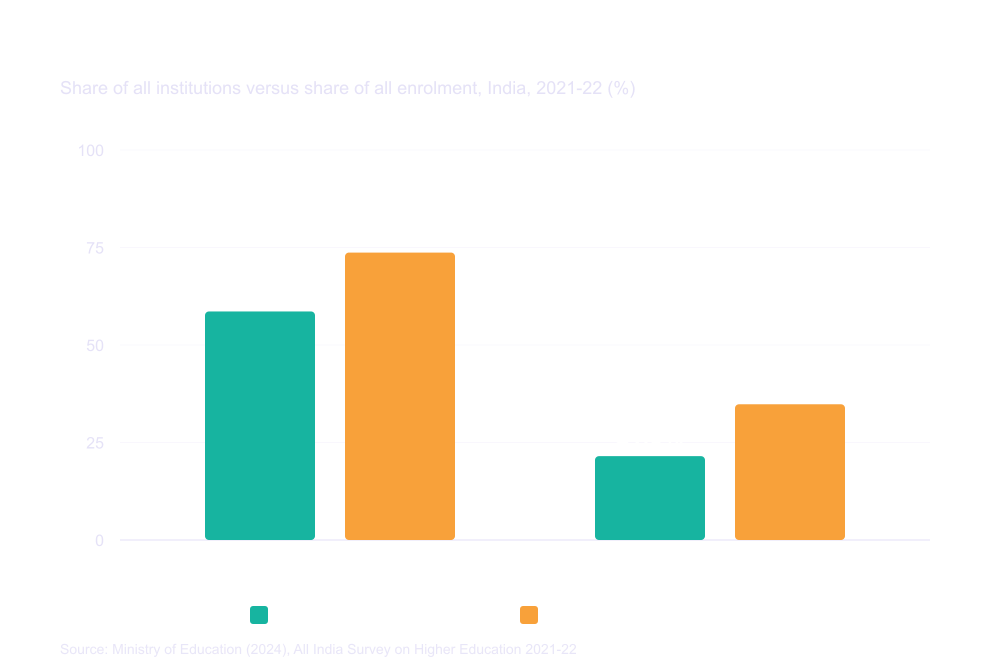
India's public-sector institutions are rich in the first. Government universities were 58.6% of all universities in 2021-22 yet carried 73.7% of enrolment (Ministry of Education 2024). Gross enrolment has since reached 30.0%, against the NEP 2020 target of 50% by 2035 (Education for All in India 2026; Ministry of Human Resource Development 2020). Closing that gap depends less on adding seats than on whether public institutions can deliver employable learning at scale.
Why Public-Sector Institutions Hold Capacity but Lack Capability
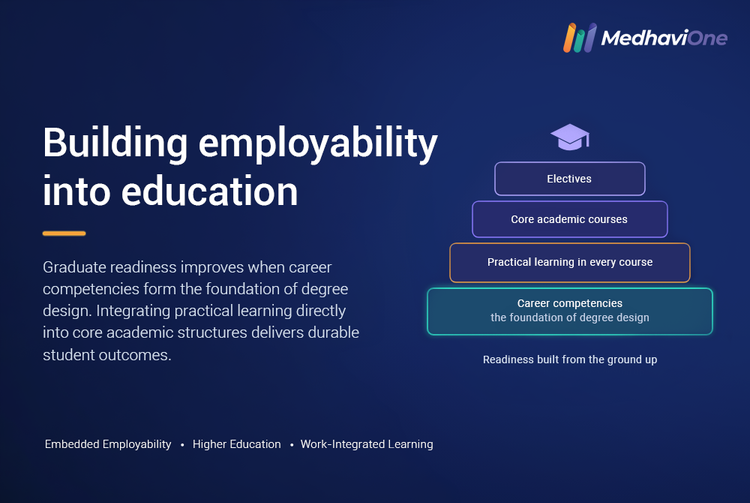
What is usually missing is the operating layer: the routines that turn a mandate into delivery, from admission to alumni. Policy now assumes that layer exists. UGC guidelines let institutions embed apprenticeship training inside an undergraduate degree (UGC 2025). Professors of Practice can make up to 10% of sanctioned posts, with formal academic qualifications not essential where professional practice is exemplary (UGC 2022).
The evidence that the gap lies in capability rather than funds is visible in skilling. By May 2026, 19 states and Union Territories had invited anchor industry partners for PM-SETU's ITI clusters, but only four had reached the request-for-proposal stage. The ministry told a parliamentary committee that the shortfall was not money but experience of running ITIs (Chettri 2026).
Parentage is not destiny, either. Pandit Deendayal Energy University, promoted by a Gujarat government undertaking, reports over 200 guest faculty from industry (PDEU 2025). That is an operating choice, not a mandate.
What an Academic Operating System Contains
In the institutional sense, an operating system is five layers that work together and survive a change of leadership.
- Curriculum architecture. Programmes designed backwards from occupations, with credits that can carry apprenticeship hours.
- Faculty and practitioner model. Core faculty alongside Professors of Practice, including industry-funded roles (UGC 2022).
- Assessment and credentialing. Workplace tasks assessed jointly with employers and recorded against credits.
- Industry integration. Agreed intake, placement and review calendars with partners, rather than one-off MoUs.
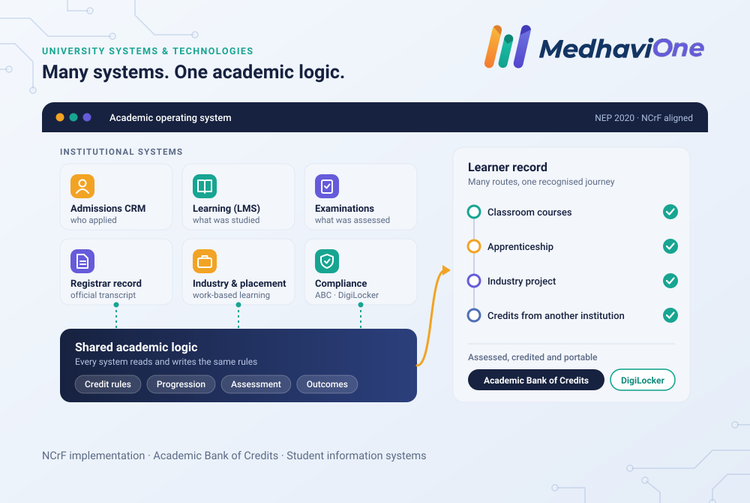
- Data and governance. One learner record from admission to alumni, outcome dashboards, and compliance mapped to whichever regulator applies.
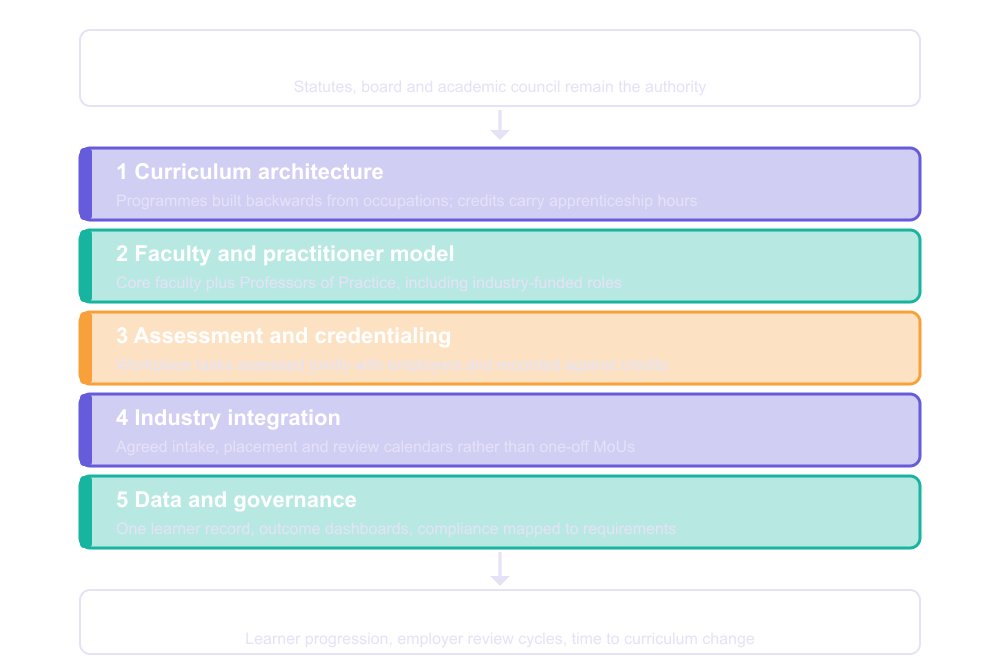
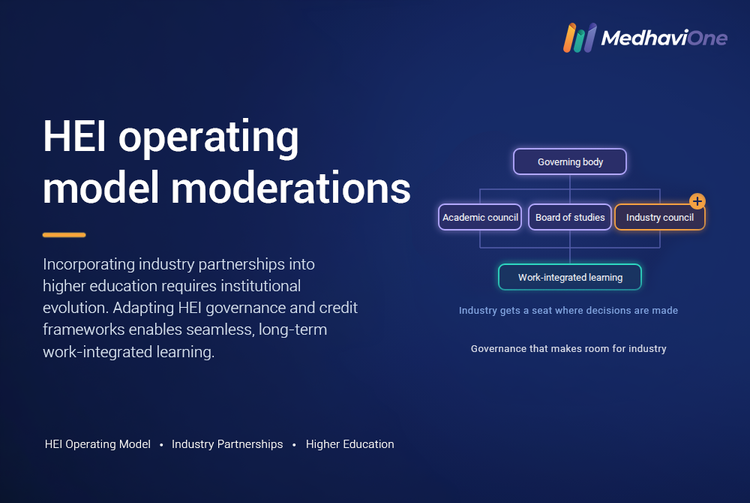
Throughout, the institution's own statutes and academic bodies remain the authority. The operating system is how decisions get executed, not who takes them.
Working Within Public-Sector Rules, Not Around Them
The common mistake is to treat approvals, sanctioned posts and regulator timelines as obstacles to bypass. Institutions that build capability treat them as design inputs. Four constraints recur, and each has a workable response.
None of these responses needs new legislation. They need one accountable owner for sequencing: which approval comes first, which can run in parallel, and what can be piloted within existing authority while larger approvals proceed.
A 36-Month Build: Map, Prove, Embed
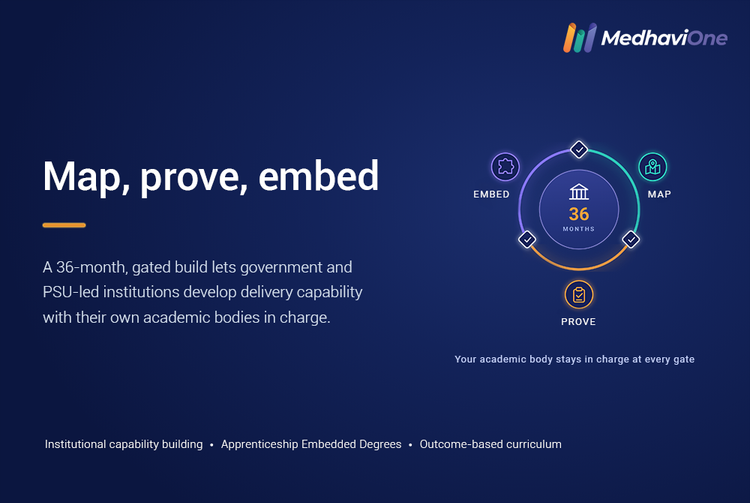
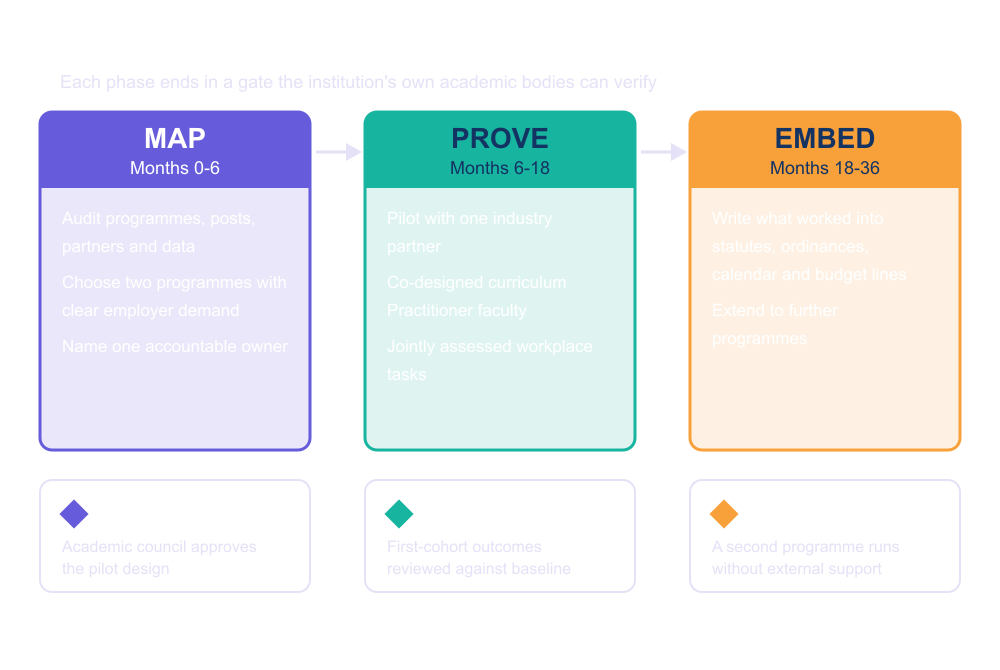
Capability is built in sequence, and each phase ends in a gate that the institution's own academic bodies can verify.
- Map (months 0-6). Audit programmes, posts, partners and data. Choose two programmes where employer demand is clear, and name one accountable owner. Gate: the academic council approves the pilot design.
- Prove (months 6-18). Run the pilot with one industry partner: co-designed curriculum, practitioner faculty, jointly assessed workplace tasks. Gate: first-cohort outcomes reviewed against the baseline.
- Embed (months 18-36). Move what worked into statutes, ordinances, the academic calendar and budget lines, then extend to further programmes. Gate: a second programme runs without external support.
How to Tell Whether Capability Is Real
Enrolment and completion figures show capacity. Five indicators show capability, and each should be set against the institution's own baseline, since benchmarks differ by discipline and region.
- Share of programmes whose curriculum was reviewed with employers in the last cycle
- Share of credits carrying a workplace-assessed component
- Practitioners' share of teaching hours
- Days from an employer's curriculum request to an approved change
- Learners moving into work or apprenticeship within a window the institution sets
Capability Is Built, Not Declared
This is the territory in which MedhaviOne University Systems & Technologies (MUST) works with higher education institutes: academic operating systems that sit inside an institute's own governance. The institute keeps its statutory authority and awards its own qualifications. The mandate belongs to the institution; the capability has to be built, one routine at a time.
References
Chettri, S. (2026) 'PM-SETU stumbles on first step as MSDE scheme to upgrade ITIs struggles to find industry partners', Careers360, 26 May.
Education for All in India (2026) 'AISHE data returns: did India close the gap to 50% GER by 2035?', 12 July.
Ministry of Education (2024) All India Survey on Higher Education 2021-22. New Delhi: Department of Higher Education, Government of India.
Ministry of Human Resource Development (2020) National Education Policy 2020. New Delhi: Government of India.
Pandit Deendayal Energy University (2025) Fact file of Pandit Deendayal Energy University. Gandhinagar: PDEU.
PRS Legislative Research (2026) The Viksit Bharat Shiksha Adhishthan Bill, 2025: bill brief. New Delhi: PRS Legislative Research.
University Grants Commission (2022) Guidelines for engaging Professor of Practice in universities and colleges. New Delhi: UGC.
University Grants Commission (2025) Guidelines for higher educational institutions to offer Apprenticeship Embedded Degree Programme (AEDP). New Delhi: UGC.
Frequently asked questions
It is an institution's ability to deliver curriculum, faculty, assessment, industry linkage and data routines reliably every term, whoever holds office.
Yes. The UGC Professor of Practice route allows up to 10% of sanctioned posts, outside the regular posts, subject to the institution's own statutes (UGC 2022).
No. Existing UGC guidance already permits apprenticeship-embedded degrees and practitioner faculty (UGC 2022; UGC 2025). Because the regulator may change, compliance should be mapped to requirements rather than to bodies.
The phased model in this article runs 36 months, with first-cohort outcomes reviewed by month 18.